Blog

  • Enterprise Generative AI Development in the UAE: Architectural Frameworks, MLOps, and Regional Scaling

    Enterprise Generative AI Development in the UAE: Architectural Frameworks, MLOps, and Regional Scaling

    Artificial intelligence has entered a crucial evolutionary stage across the United Arab Emirates. Supported by government initiatives like the UAE National Strategy for Artificial Intelligence and rapid digital transformation across Dubai, Abu Dhabi, and Sharjah, enterprise organizations are moving beyond consumer-facing AI chatbots. Enterprises are now building custom foundation models, autonomous agent networks, and retrieval-augmented generation (RAG) pipelines integrated directly into core operations.

    Executing enterprise-grade enterprise generative AI development requires far more than basic API integrations with third-party providers. It demands custom model fine-tuning (using parameter-efficient methods like LoRA and QLoRA), robust vector database architecture, automated MLOps infrastructure, and real-time security guardrails that guarantee regulatory compliance and zero data leakage.

    This guide delivers an architectural and business blueprint for managing generative ai development initiatives across the UAE and GCC regions, covering technical stack decisions, security guardrails, MLOps orchestration, and real-world enterprise deployments.

    The State of Enterprise Generative AI in the UAE

    Enterprise leaders in Dubai and Abu Dhabi face distinct operational demands when evaluating artificial intelligence infrastructure. Organizations in finance, government, logistics, and digital media must navigate strict data residency guidelines while scaling low-latency applications for multi-lingual demographics (Arabic and English).

    +-------------------------------------------------------------------------------+
    |                      UAE Enterprise GenAI Adoption Drivers                    |
    +---------------------------------------+---------------------------------------+
    |        Technical & Operational        |       Governance & Compliance         |
    |  • Low-latency inference engines      |  • UAE Data Protection Law compliance |
    |  • Bilingual accuracy (Arabic / Eng)  |  • Role-Based Access Control (RBAC)   |
    |  • Private cloud & on-prem hosting    |  • Zero public data retention policies|
    +---------------------------------------+---------------------------------------+
    

    Strategic Growth Factors

    • Local Cloud Infrastructure: Expanding regional data centers (AWS, Azure, Google Cloud, and local sovereign clouds) enable ultra-low-latency model inference and local data residency.
    • Domain-Specific Arabic Language Models: Standard global LLMs often struggle with dialectal Arabic nuance and localized business context. Fine-tuning models on domain-specific GCC datasets is essential for accuracy.
    • Autonomous Decision Workflows: Engineering teams are shifting from passive conversational interfaces toward multi-agent frameworks capable of executing complex business logic across enterprise software ecosystems.

    Planning a sustainable deployment requires a strategic approach similar to formulating an enterprise OTT Business Plan, balancing GPU compute costs against operational efficiency and long-term business value.

    Core Architectural Pillars of Enterprise GenAI Systems

    A production-grade generative AI deployment relies on a decoupled, multi-layered software architecture. Every component must handle high query throughput, continuous vector search, and strict context evaluation.

    1. Data Ingestion, Processing, and Vector Storage

    Unstructured enterprise data (PDFs, SQL databases, API logs, media transcripts) passes through automated ETL pipelines. Documents are split into semantic chunks, passed through embedding models, and stored in high-performance vector databases (such as Pinecone, Milvus, or Qdrant) alongside rich metadata for hybrid sparse-dense retrieval.

    2. Semantic Routing and Orchestration

    Frameworks like LangChain, LlamaIndex, or custom Python orchestration engines manage incoming user requests. A semantic router determines whether an incoming query requires simple vector retrieval, direct SQL execution, or multi-step reasoning via autonomous AI agents.

    3. Specialized NLP and Computer Vision Integration

    Modern enterprise systems process mixed media inputs. Incorporating advanced named entity recognition (NER) and intent parsing alongside computer vision engines enables pipelines to analyze complex technical schematics, visual documents, and video feeds in parallel with natural language queries.

    End-to-End System Architecture Diagram & Data Workflow

    The following diagram illustrates how user queries move from client interfaces through security guardrails, semantic routing, vector stores, and custom fine-tuned models down to MLOps observability tools.

    +---------------------------------------------------------------------------------+
    |                  Enterprise Generative AI System Pipeline                       |
    +---------------------------------------------------------------------------------+
    |                                                                                 |
    |  [ User / API Client ] ------> [ Real-Time Input Guardrails & PII Redaction ]   |
    |                                                |                                |
    |                                                v                                |
    |                              [ Semantic Router & Agent Engine ]                 |
    |                                                |                                |
    |                    +---------------------------+---------------------------+    |
    |                    |                                                       |    |
    |                    v                                                       v    |
    |      [ Vector Database & Hybrid RAG ]                    [ Fine-Tuned Local LLM ]
    |      (Pinecone / Milvus / Qdrant)                        (Llama 3 / Mistral / Falcon)
    |                    |                                                       |    |
    |                    +---------------------------+---------------------------+    |
    |                                                |                                |
    |                                                v                                |
    |                             [ Output Sanitization & Hallucination Filter ]      |
    |                                                |                                |
    |                                                v                                |
    |                              [ MLOps & Observability Dashboard ]                |
    |                                (LangSmith / Arize / OpenTelemetry)              |
    |                                                                                 |
    +---------------------------------------------------------------------------------+
    

    Architectural Comparison: RAG vs. Fine-Tuning vs. AI Agents

    Selecting the right technological approach depends on data update frequency, specialized task requirements, and latency budgets.

    Technical DimensionRetrieval-Augmented Generation (RAG)Custom Model Fine-Tuning (PEFT/LoRA)Autonomous AI Agent Frameworks
    Primary FunctionDynamic factual knowledge retrievalModifying task style, tone, and domain syntaxExecuting multi-step reasoning and API tools
    Knowledge FreshnessReal-time (pulls live database records)Static (frozen at training time)Dynamic (queries external tools in real-time)
    Hallucination RiskLow (anchored strictly to retrieved sources)Moderate (susceptible to knowledge drift)Low to Moderate (depends on tool feedback loops)
    Setup Timeline2 to 4 Weeks2 to 4 Months2 to 3 Months
    Compute OverheadLow (Vector Search + Base Inference)High (GPU Training Clusters + Data Prep)Variable (Multiple LLM calls per workflow)
    Best Use CaseKnowledge bases, customer support, policiesCode generation, specialized formattingWorkflow automation, system integration

    Most enterprise architectures adopt a Hybrid Approach: fine-tuning open-weights models (such as Llama 3 or Falcon) on domain-specific formatting, then pairing them with a RAG pipeline for factual retrieval and autonomous agents for tool execution.

    Enterprise Security, Governance, and Guardrails Stack

    Deploying AI systems within enterprise environments requires strict security boundaries to protect proprietary IP and comply with UAE data privacy frameworks.

                          +-----------------------------------+
                          |   Enterprise AI Security Engine   |
                          +-----------------+-----------------+
                                            |
            +-------------------------------+-------------------------------+
            |                               |                               |
            v                               v                               v
    +------------------+           +------------------+           +------------------+
    | Input Guardrails |           | Vector Metadata  |           | Isolated Private |
    | (Prompt Injection|           | RBAC Filtering   |           | VPC Hosting      |
    |  & PII Masking)  |           | (Tenant Isolation|           | (AWS GovCloud /  |
    +------------------+           +------------------+           +------------------+
    

    1. Real-Time Input and Output Guardrails

    Every prompt entering the system passes through automated sanitization layers. Input guardrails detect prompt injection attacks, mask personally identifiable information (PII), and block toxic inputs. Output guardrails analyze generated responses to filter hallucinations and enforce structured formatting (such as valid JSON schemas).

    2. Role-Based Access Control (RBAC) in Vector Search

    Users must only retrieve data they are authorized to access. Enterprise RAG architectures embed user permissions and tenant IDs directly into vector metadata, ensuring search queries automatically filter out restricted documents at the database layer.

    3. Private Cloud Deployment

    To meet strict regional compliance standards, systems can be deployed within an organization’s private AWS, Azure, or on-premises GPU infrastructure, ensuring complete isolation from public LLM endpoints.

    Real-World Regional Industry Use Cases

    Case 1: Financial Services – Automated Compliance & Audit Analysis

    • Challenge: Analyze complex financial regulatory documents and trade records across Dubai and Abu Dhabi while adhering to strict privacy rules.
    • Architecture: Deployed a private RAG pipeline connected to encrypted document stores with real-time audit logging and PII masking.
    • Outcome: Reduced document review cycles by 80% while ensuring zero data exposure to external networks.

    Case 2: Government & Public Sector – Multilingual Service Desk

    • Challenge: Deliver accurate, instant customer support in both formal Arabic and English across public service platforms.
    • Architecture: Utilized a fine-tuned open-weights model integrated with automated semantic routing and specialized translation guardrails.
    • Outcome: Increased first-contact resolution rates to 92% across digital service portals in Sharjah and Dubai.

    Strategic Integration with Digital Media & OTT Infrastructure

    One of the most transformative applications of generative ai development lies in modernizing digital streaming infrastructure. Media companies, broadcasters, and telecoms are utilizing artificial intelligence to streamline content workflows, automate metadata tagging, and personalize user experiences.

    +-------------------------------------------------------------------------------+
    |                       AI-Driven Media Ecosystem Stack                         |
    +-------------------------------------------------------------------------------+
    | [AI Metadata & Tagging] | [Automated Subtitling] | [Hyper-Personalization]    |
    +-------------------------------------------------------------------------------+
    |           Enterprise Video Pipeline Powered by ARYtech & Vodistry              |
    +-------------------------------------------------------------------------------+
    

    1. Automated Metadata Tagging & Content Discovery

    Integrating generative models into enterprise Video Content Management Systems allows media operators to automatically generate scene descriptions, extract key topics, and generate localized subtitles in real time. Deploying an enterprise-grade Video CMS connected to specialized AI models simplifies catalog management for massive video archives.

    2. Hyper-Personalized User Experiences

    Streaming services utilize AI algorithms to build dynamic user interfaces. By leveraging a low-code Experience builder, product teams can dynamically alter application layouts, content rows, and promotional banners based on real-time user viewing preferences. Adding real-time engagement features like AI-moderated chat and live polling via integrated Interactivity modules drives higher viewer retention.

    3. AI-Enhanced Stream Security and Monetization

    Protecting high-value media catalogs requires robust security layers alongside intelligent monetization frameworks:

    Deploying these technologies through a modular platform like Vodistry—developed by an established OTT platform development company UAE like ARYtech—enables media operators to launch next-generation OTT Streaming Services rapidly.

    Furthermore, platforms utilizing automated Cloud playout can assemble AI-curated linear channels from VOD catalogs, while monitoring playback quality via advanced video Analytics engines. Media operators seeking to create your own OTT platform can significantly accelerate execution timelines by deploying pre-integrated platform engines.

    Best Practices for Enterprise AI Scaling

    1. Decouple Application Logic from Model Providers: Avoid vendor lock-in by using open-source orchestration layers. This allows switching between third-party APIs and self-hosted open-weights models as cost and performance requirements change.
    2. Implement Semantic Caching: Up to 30% of enterprise queries are repetitive. Implementing a semantic cache (such as Redis Vector Search) returns cached answers for similar queries instantly, drastically reducing compute costs and latency.
    3. Establish Continuous MLOps Observability: Track model performance using real-user monitoring tools to measure context relevancy, answer faithfulness, and token burn rates across business units.
    4. Plan for Complex System Integrations: Connecting AI engines with legacy enterprise databases and media pipelines requires careful system architecture. Review our guide on OTT System Integration to streamline workflow pipelines.
    5. Leverage Strategic Advisory: Partnering with technical experts for specialized OTT Consulting Services helps align AI architecture with broader business goals. Additionally, media networks can explore growth strategies like regional OTT Bundling Models to expand subscriber penetration.

    Frequently Asked Questions (FAQs)

    1. What is enterprise generative AI development?

    Enterprise generative AI development involves engineering custom artificial intelligence systems—including fine-tuned large language models, RAG pipelines, and autonomous agents—tailored to an organization’s proprietary data, security requirements, and operational workflows.

    2. How do enterprise AI solutions ensure data privacy and regional compliance in the UAE?

    Enterprise systems enforce data privacy through private VPC hosting, local cloud deployment, PII redaction, role-based vector filtering, and strict zero-data-retention policies with model providers.

    3. What is the difference between RAG and model fine-tuning?

    RAG dynamically retrieves facts from external databases at query time, making it ideal for live knowledge bases. Fine-tuning modifies an LLM’s internal weights to adapt its tone, style, or task-specific formatting.

    4. How can artificial intelligence improve digital video and OTT platforms?

    AI optimizes video platforms by automating metadata generation, creating real-time subtitling, personalizing content recommendations, driving dynamic ad insertion, and detecting stream anomalies.

    5. How long does it take to deploy an enterprise generative AI solution?

    A functional production MVP can typically be built and deployed within 8 to 12 weeks. Full enterprise deployments—including integration with legacy databases, penetration testing, and automated MLOps implementation—take between 4 to 6 months.

    6. How do autonomous AI agents differ from standard chatbots?

    Standard chatbots provide single-turn conversational answers. Autonomous AI agents receive high-level goals, break them down into sub-tasks, execute API tools, evaluate results, and complete multi-step workflows independently.

    7. What hosting infrastructure is required for fine-tuned LLMs?

    Hosting fine-tuned models requires dedicated GPU compute instances (such as Nvidia H100 or A100 GPUs) managed via optimized inference engines (like vLLM or TensorRT-LLM) on auto-scaling Kubernetes clusters.

    8. How can media platforms evaluate turnkey streaming engines vs. custom builds?

    Media operators can compare modular platforms like Vodistry against custom microservices builds to balance initial CapEx, time-to-market constraints, and long-term maintenance overhead.

    Architectural Conclusion & Next Steps

    Executing a successful generative ai development strategy across the UAE requires balancing model performance, cloud security, and operational scalability. As regional organizations shift toward autonomous agent workflows, domain-specific language models, and intelligent media pipelines, building robust infrastructure is essential for long-term digital leadership.

    Whether your organization is deploying custom AI pipelines, integrating automated video workflows, or modernizing enterprise applications, working with experienced architects ensures your technology scales securely. Explore specialized enterprise engineering through ARYtech and review modern platform engines like Vodistry to accelerate your digital transformation across Dubai, Abu Dhabi, and the broader GCC region.

  • The Day YouTube Passed the BBC

    The Day YouTube Passed the BBC

    At the end of 2025, according to BARB, the industry body that measures UK television audiences, YouTube did something that had never happened before: it overtook the BBC in total audience reach across British screens, registering 51.9 million viewers in a single month. Not a niche measurement, not a streaming-only subcategory. Total reach, the same measurement built, originally, to track how many people a national broadcaster commanded.

    For a platform still culturally associated with amateur video and unboxing clips, that’s a strange kind of victory. It’s also exactly the number that explains why so many brands, publishers, and media companies now find themselves asking a question that would have sounded absurd a decade ago: do we actually need our own streaming presence, or is YouTube just… enough?

    What YouTube has actually built

    The scale here is hard to overstate. In the US alone, YouTube reaches over 238 million people aged 18 and older across all devices, and by multiple 2026 industry accounts it’s the number one streaming platform by watch time, ahead of Netflix, ahead of Disney+, ahead of every traditional broadcaster tracked. Connected TV has become its fastest-growing format, with CTV ad conversions on the platform reportedly growing over 200% year-over-year into 2026. At its 2026 Brandcast presentation, YouTube’s own leadership made the positioning explicit: CEO Neal Mohan opened by declaring “the YouTube era,” and the platform spent the rest of the event demonstrating, through new shopping tools, AI-assisted ad creative, and a slate of creator-led original shows, that it isn’t trying to sit alongside television anymore. It’s trying to replace the category entirely.

    So why would anyone build their own platform instead?

    Here’s the tension worth sitting with honestly: everything above is a genuine, well-earned argument for staying on YouTube rather than building anywhere else. The reach is real. The discovery engine is real. For most creators and most brands, most of the time, YouTube is exactly enough.

    But reach and ownership are different things, and YouTube’s own economics make that difference concrete rather than abstract. A creator or brand’s YouTube revenue flows through YouTube’s terms, its monetization policies, its Partner Program rules, all of which the platform can and does change unilaterally. The audience data a channel generates, who’s watching, what they do afterward, largely stays inside Google’s ecosystem rather than becoming something the channel owner can use directly. And the discovery mechanism that makes YouTube so powerful, its recommendation algorithm, is also the mechanism that can quietly reduce a channel’s reach overnight, for reasons the channel owner doesn’t control and often can’t fully diagnose.

    A live example of the “and,” not “or”

    The clearest evidence that serious media organizations see this as an addition rather than a replacement showed up in December 2025, when MS NOW, the streaming venture built around what had been MSNBC, announced plans for its own direct-to-consumer offering, explicitly designed to stitch together its own content alongside podcasts, YouTube, and short-form video, rather than choosing one channel over the others. The company’s own language was telling: it described the plan as building “a home” for its audience, on its own terms, while still treating YouTube and social video as part of the broader distribution mix, not something to be abandoned.

    The explainer moment: what YouTube structurally can’t give you

    What is it, in plain terms? YouTube is a platform you publish onto. An owned OTT presence is a platform you control.

    Why does that distinction matter? Because publishing onto someone else’s platform means the terms, monetization split, algorithm behavior, and audience data all belong, structurally, to that platform, not to the publisher. An owned platform makes the publisher the one setting those terms.

    How does that play out in practice? A branded app or streaming presence lets an organization capture direct viewer data, control its own monetization mix, subscription, advertising, sponsorship, without a platform’s revenue share attached, and build a relationship with its audience that survives an algorithm update untouched.

    Then vs. now

    Then: a brand’s video presence lived entirely inside YouTube’s numbers, its recommendation engine, its ad revenue split.

    Now: the smartest media organizations run both, YouTube for the reach and discovery nothing else can match, and an owned platform for the relationship, data, and monetization terms YouTube was never built to hand over.

    The honest counterargument, restated plainly

    Building an owned platform isn’t automatically the right call for everyone reading this. It requires content volume sufficient to sustain two channels, a genuine reason audiences would follow you somewhere beyond YouTube, and a realistic accounting of the cost, in both money and ongoing content commitment, against what an owned presence actually returns. For plenty of creators and brands, that math doesn’t work yet, and pretending otherwise would be dishonest.

    What this means for the business

    The real decision isn’t YouTube versus an owned platform. It’s what specifically an organization is trying to own, the audience relationship, the monetization terms, the first-party data, and whether YouTube’s reach, on its own, gets that organization there. For most, the honest answer is that YouTube gets you discovered, and an owned platform is what lets you keep what YouTube helped you find.

    Where the second half of that equation fits

    This is where a platform such as VODistry becomes relevant, specifically and only for the owned-platform half of that equation: the branded app, the direct monetization, the first-party audience data an organization builds once it’s decided YouTube’s reach alone isn’t the whole strategy. It doesn’t compete with YouTube for discovery, and pretending it could would be exactly the kind of overreach this series has tried to avoid throughout.

    What’s next

    Expect more organizations to follow the MS NOW pattern explicitly, building owned platforms designed from the start to coexist with YouTube and social distribution rather than replace them, as the industry increasingly treats “YouTube versus owned OTT” as the wrong framing entirely, and “YouTube and owned OTT, doing different jobs” as the right one.

  • OTT Development Cost 2026: Enterprise Cost Breakdown, Architecture, and Regional ROI in the UAE

    OTT Development Cost 2026: Enterprise Cost Breakdown, Architecture, and Regional ROI in the UAE

    Building a commercial streaming app across the United Arab Emirates and the broader Middle East has evolved into a strategic necessity for broadcasters, telecommunications operators, and sports rights holders. With near-ubiquitous 5G connectivity, high smartphone penetration, and shifting viewer habits across Dubai, Abu Dhabi, Sharjah, and regional hubs, launching an over-the-top media platform requires a clear understanding of capital expenditure (CapEx) and operational expenditure (OpEx).

    Navigating the OTT development cost 2026 landscape demands evaluating several interconnected cost variables: cloud infrastructure scaling, multi-device app packaging, dynamic ad insertion (DAI), multi-DRM security, and localized payment integrations with telecom providers like e& and du. Partnering with an experienced OTT platform development company UAE enables media enterprises to balance technical architecture with clear revenue projections.

    This comprehensive guide breaks down enterprise costs, architectural decisions, hidden operational fees, and investment strategies for streaming projects across the UAE and GCC region in 2026.


    Executive Summary: What Drives OTT Development Cost 2026?

    Calculating an accurate budget for an enterprise video service goes far beyond initial software coding. Modern streaming platforms operate as distributed cloud systems that incur ongoing bandwidth, transcoding, licensing, and security costs as viewer traffic scales.

    +-------------------------------------------------------------------------------+
    |                       Core Cost Components for UAE Platforms                  |
    +---------------------------------------+---------------------------------------+
    |        Capital Expenditure (CapEx)    |      Operational Expenditure (OpEx)   |
    |  • Native Mobile & Smart TV Apps      |  • Multi-CDN Egress & Transcoding     |
    |  • UI/UX Design & Custom Player Engine |  • Multi-DRM License Token Fees       |
    |  • Payment Gateway & DCB Integrations |  • Video CMS Cloud Hosting & Maintenance|
    +---------------------------------------+---------------------------------------+
    

    Strategic Regional Budget Drivers

    • Multi-Device Target Ecosystems: Launching across iOS, Android, Apple TV, Android TV, Samsung Tizen, and LG WebOS increases initial frontend development costs.
    • Localization & Payment Integrations: Support for Arabic/English right-to-left (RTL) interfaces, multi-currency checkouts, and Direct Carrier Billing (DCB) requires custom middleware.
    • Studio-Grade Content Security: Content owners licensing high-value live sports or Ramadan series must budget for multi-DRM license tokens and dynamic forensic watermarking.

    Establishing an accurate budget starts with a well-researched OTT Business Plan that aligns technical expenditure with subscriber acquisition and lifetime value (LTV).

    Tiered Cost Estimates: Startup MVPs to Enterprise Platforms

    To help enterprise leaders plan budgets, the following table outlines typical cost ranges, development timelines, and feature scopes for streaming deployments in 2026.

    Platform TierScope & Target AudienceEstimated CapEx Budget (USD)Estimated Timeline
    Basic MVP / Niche VODWeb platform + iOS/Android apps, basic SVOD, standard VOD catalog$25,000 – $45,0002 – 3 Months
    Mid-Market Streaming ServiceMobile + Smart TV apps (Tizen/WebOS), live channel ingestion, basic DRM, AVOD/SVOD hybrid$50,000 – $90,0003 – 5 Months
    Enterprise Broadcast / SportsFull multi-device app matrix, low-latency live streaming, multi-DRM, SSAI ad integration, DCB billing$100,000 – $250,000+6 – 10 Months
    Custom Telecom / Multi-TenantScalable microservices, multi-region CDN routing, custom analytics, white-label tenant management$250,000 – $500,000+9 – 14 Months

    Key Technical Cost Drivers in Streaming Architecture

    The total OTT development cost 2026 is determined by four primary architectural pillars:

    1. Ingestion, Transcoding, and Packaging Pipelines

    Live streams and VOD source files must be encoded into adaptive bitrate (ABR) profiles (H.264, H.265/HEVC, AV1) and dynamically packaged into HLS and MPEG-DASH formats. Dynamic packaging eliminates static file duplicates, reducing storage overhead while ensuring compatibility across all screen sizes.

    2. Media Orchestration & Metadata Governance

    Managing expansive media catalogs requires a flexible orchestration engine. Implementing dedicated Video Content Management Systems ensures editorial teams can curate content schedules, localized metadata, and multi-language audio tracks. Utilizing an enterprise-grade Video CMS provides the central API layer required to feed client applications reliably.

    3. Multi-Device Native App Matrices

    Developing separate native codebases for iOS (Swift), Android (Kotlin), Samsung Tizen, LG WebOS, and Apple TV accounts for 40% to 50% of initial software development costs. Cross-platform frameworks can lower upfront costs but may require custom player optimizations for Smart TV platforms.

    Architecture Diagram & Workflow Overhead

    The following architecture diagram illustrates how media files move from source ingestion through packaging, security layers, and multi-CDN distribution down to client applications, along with their associated cost drivers.

    +---------------------------------------------------------------------------------+
    |               Enterprise Video Pipeline & Cost Allocation Map                   |
    +---------------------------------------------------------------------------------+
    |                                                                                 |
    |  [ Live / VOD Ingestion ] ---------> [ Cloud Transcoding (Per Minute Fee) ]     |
    |                                                     |                           |
    |                                                     v                           |
    |                                     [ Just-In-Time Dynamic Packaging ]          |
    |                                                     |                           |
    |                    +--------------------------------+--------------------+      |
    |                    |                                |                    |      |
    |                    v                                v                    v      |
    |         ( Multi-DRM Gateway )               ( SSAI Ad Server )    ( Video CMS ) |
    |         [$0.002-$0.008 / License]           [eCPM Rev Share]      [Monthly SaaS]|
    |                    |                                |                    |      |
    |                    +--------------------------------+--------------------+      |
    |                                                     |                           |
    |                                                     v                           |
    |                                     [ Multi-CDN Switching Layer ]               |
    |                                     [ Bandwidth Egress $ / GB ]                 |
    |                                                     |                           |
    |         +-------------------------------------------+------------------------+  |
    |         |                                           |                        |  |
    |         v                                           v                        v  |
    |  [ iOS / Apple TV App ]                     [ Android / Smart TV ]    [ Web ]   |
    |  [ Custom CapEx Build ]                     [ Custom CapEx Build ]    [ Build ] |
    |                                                                                 |
    +---------------------------------------------------------------------------------+
    

    Build vs. Buy Financial Analysis: Custom Microservices vs. Modular Platforms

    Choosing between custom microservices engineering and deploying a modular platform engine is a major financial decision for streaming providers.

    Cost & Operational DimensionCustom Microservices BuildModular / White-Label Platform
    Initial Upfront CapExHigh ($150,000 – $400,000+)Moderate ($20,000 – $60,000)
    Time-to-Market9 to 18 Months2 to 4 Months
    In-House Engineering TeamRequires dedicated DevOps & Player EngineersMinimal; managed by platform vendor
    Annual Maintenance Overhead15% – 20% of initial build cost annuallyIncluded in monthly SaaS / OpEx agreement
    Feature Customization100% bespoke flexibilityHigh via configurable design frameworks
    Risk of Cost OverrunsHigh due to shifting technical scopeLow; predictable pricing tiers

    Deploying established White Label OTT Solutions offers a proven middle ground. It provides pre-built client applications for web, mobile, and Smart TVs while preserving open APIs for custom backend integrations. Organizations evaluating options to create your own OTT platform can significantly reduce time-to-market and CapEx risk by leveraging modular engines.

    Security Stack Costs: Multi-DRM, Watermarking, and Geo-Blocking

    Protecting high-value media rights against regional digital piracy requires an enterprise security stack. Single-DRM configurations are insufficient because modern web browsers, mobile operating systems, and Smart TVs enforce distinct decryption standards.

                          +-----------------------------------+
                          |   Multi-DRM Licensing Gateway     |
                          +-----------------+-----------------+
                                            |
            +-------------------------------+-------------------------------+
            |                               |                               |
            v                               v                               v
    +------------------+           +------------------+           +------------------+
    | Google Widevine  |           |  Apple FairPlay  |           | Microsoft        |
    | (Android, Chrome)|           |  (iOS, Safari,   |           | PlayReady        |
    |                  |           |   Apple TV)      |           | (Smart TVs, Edge)|
    +------------------+           +------------------+           +------------------+
    

    1. Studio-Grade Multi-DRM Licensing

    Securing digital assets requires implementing three major encryption engines simultaneously:

    • Google Widevine (L1/L3): Protects Android smartphones, Chrome browsers, and Android TV units.
    • Apple FairPlay Streaming: Protects HLS streams delivered to iOS, Safari, and Apple TV hardware.
    • Microsoft PlayReady: Secures DASH streams on Smart TV ecosystems (Samsung Tizen, LG WebOS) and Windows devices.

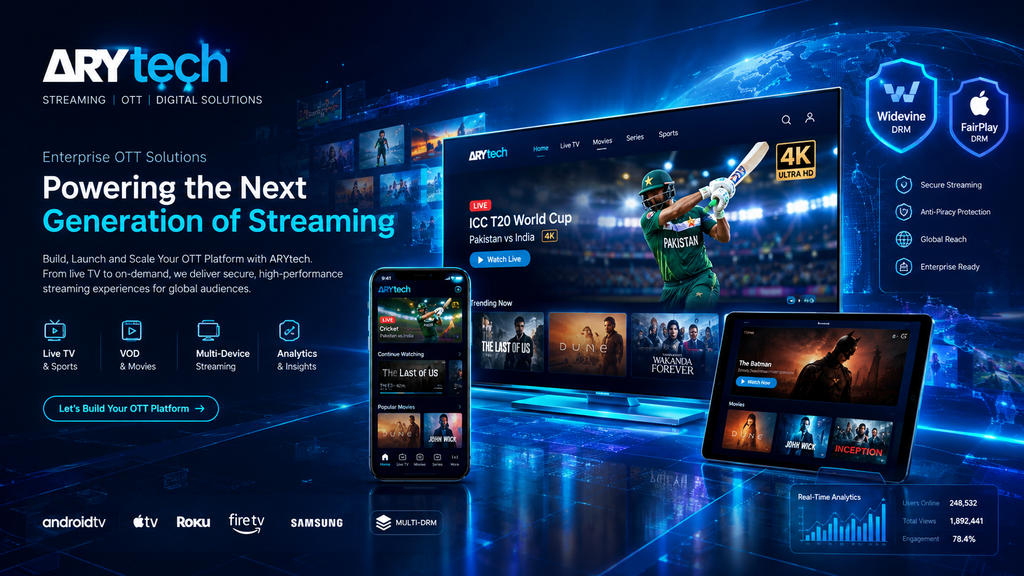
    Deploying comprehensive Digital Rights Management involves license server integration fees and usage-based token costs (typically $0.002 to $0.008 per license request). Using dedicated Digital Rights Management Software simplifies license key exchanges and prevents screen recording. Platforms upgrading legacy setups can execute an OTT DRM Replacement strategy to maintain uninterrupted playback for active subscribers. Learn how to structure a multi-DRM pipeline in our detailed guide on Multi DRM.

    2. Forensic Watermarking & Geo-Blocking Infrastructure

    • IP Intelligence & Geo-Fencing: Licensing agreements mandate blocking viewers outside licensed territories. Integrating IP intelligence engines blocks traffic originating from VPNs and open proxies across Dubai, Abu Dhabi, and international regions.
    • Session Watermarking: Embeds invisible viewer IDs into the video buffer, allowing security teams to identify the source of leaked streams within minutes.
    image

    Ongoing Operational Expenditure (OpEx) & Hosting Cost Factors

    Beyond initial software development, platform owners must budget for variable cloud infrastructure fees.

    1. Cloud Storage & CDN Bandwidth Egress

    • VOD Storage: Cloud storage for a 1,000-hour HD library averages $200 – $500/month.
    • CDN Delivery Costs: Bandwidth egress in the Middle East ranges from $0.03 to $0.08 per GB. Streaming 100,000 hours of HD video monthly equates to roughly 150,000 GB, translating to $4,500 – $9,000 in monthly CDN expense.

    2. Live Transcoding & SSAI Ad Insertion

    • Live Transcoding: Cloud encoding fees range from $0.03 to $0.10 per stream minute depending on input resolution and frame rate.
    • Server-Side Ad Insertion (SSAI): SSAI stitching engines typically charge on a per-thousand-impressions (CPM) basis ($0.10 – $0.30 per 1,000 ad insertions).

    Strategic Monetization & Recouping Infrastructure Investment

    To offset infrastructure OpEx, modern streaming services deploy hybrid monetization models tailored to regional market preferences.

                           +-----------------------------------+
                           |    Hybrid Revenue Architecture    |
                           +-----------------+-----------------+
                                             |
             +-------------------------------+-------------------------------+
             |                               |                               |
             v                               v                               v
        +---------+                     +---------+                     +---------+
        |  SVOD   |                     |  AVOD   |                     |  FAST   |
        | Recurring|                     |Targeted |                     | Cloud   |
        | Subscriptions                 | Ad Ingestion                  | Playout |
        +---------+                     +---------+                     +---------+
    
    1. Subscription Video on Demand (SVOD): Generates steady recurring revenue. Supporting local payment options—including Apple Pay, credit cards, and Direct Carrier Billing (DCB)—lowers churn rates across UAE households.
    2. Ad-Supported Video on Demand (AVOD) & FAST: Monetizes non-paying users by stitching dynamic video ads directly into the stream manifest at the cloud level, bypassing ad-blockers.
    3. Telco Distribution Partnerships: Expand reach and offset acquisition costs by partnering with regional operators via structured OTT Bundling Models.

    Deploying tailored OTT Monetization Services helps platforms maximize yield per impression (eCPM) while keeping subscriber drop-off rates low.

    Real-World UAE Case Studies

    Case 1: Sports Broadcaster – Live Event Scaling

    • Challenge: Broadcast high-stakes tournament matches to 200,000 concurrent viewers across Abu Dhabi and Dubai with sub-3-second end-to-end latency.
    • Solution: Deployed an auto-scaling cloud transcoding pipeline combined with dynamic multi-CDN switching and token-based DRM authentication.
    • Financial Impact: Kept streaming infrastructure costs predictable during peak traffic spikes while achieving 99.99% uptime, preserving live subscription revenues.

    Case 2: Media Publisher – VOD Library Migration

    • Challenge: Modernize an archive of 5,000 VOD assets and launch native Smart TV apps on a strict deadline.
    • Solution: Implemented a modular platform framework alongside an enterprise Video CMS, integrating direct carrier billing with regional telecom partners.
    • Financial Impact: Reduced initial CapEx by 60% compared to a custom build and launched across all target app stores within 90 days.

    Expert Recommendations to Optimize Capex

    • Adopt a Modular API-First Architecture: Separate front-end applications from backend microservices to allow UI updates without altering core backend code.
    • Use Low-Code UI Frameworks: Accelerate app rollouts on secondary platforms using custom design tools. Leveraging a low-code Experience builder allows teams to update app layouts and category rows dynamically without submitting app store updates.
    • Partner with Technical Advisors: Navigating complex workflows requires careful planning. Working with experts for specialized OTT Consulting Services helps avoid over-engineering and keeps project scope aligned with business goals.
    • Simplify System Integrations: Connecting payment gateways, recommendation engines, and user databases requires structured planning. Review our technical guide on OTT System Integration to design efficient system workflows.

    Turnkey Platform Cost Accelerator: Vodistry by ARYtech

    For media companies seeking to minimize initial CapEx while launching an enterprise platform, modular engines offer a cost-effective path forward.

    +-------------------------------------------------------------------------------+
    |                       Vodistry Managed Streaming Platform                     |
    +-------------------------------------------------------------------------------+
    | [Live Streaming Engine] | [Cloud Playout] | [Video Analytics] | [Multi-DRM]   |
    +-------------------------------------------------------------------------------+
    |             Managed Engineering Infrastructure by ARYtech                     |
    +-------------------------------------------------------------------------------+
    

    The Vodistry platform—powered by ARYtech—delivers a modular streaming engine built for enterprise scale. Core platform capabilities include:

    • High-Concurrency Live Streaming: Deliver broadcast-quality live events to large concurrent audiences with low latency.
    • Automated Cloud playout: Assemble 24/7 linear channels from existing VOD assets to create new ad inventory without extra hardware.
    • Real-Time video Analytics: Track Quality of Experience (QoE) metrics, buffer ratios, and subscriber retention rates through a unified dashboard.
    • Audience Engagement Extensions: Increase watch times using built-in interactive tools like live polling and chat through integrated Interactivity features.

    Whether launching new OTT Streaming Services or upgrading an existing backend, choosing a managed platform engine significantly reduces initial development costs and shortens time-to-market.

    Frequently Asked Questions (FAQs)

    1. What is the average OTT development cost in 2026 for the UAE market?

    A basic MVP platform typically costs between $25,000 and $45,000. Mid-market services range from $50,000 to $90,000, while complex enterprise platforms featuring multi-DRM, live streaming, and Smart TV apps range from $100,000 to over $250,000.

    2. What ongoing operational costs should I expect after launch?

    OpEx includes cloud hosting, CDN bandwidth egress ($0.03 – $0.08 per GB in the Middle East), DRM license tokens ($0.002 – $0.008 per request), Video CMS SaaS fees, and ongoing app maintenance (typically 15% – 20% of initial build cost annually).

    3. How can I reduce initial development costs without sacrificing quality?

    You can lower initial CapEx by launching on primary platforms first (e.g., iOS, Android, Web), utilizing a modular platform framework like Vodistry instead of building custom microservices from scratch, and leveraging multi-tenant cloud infrastructure.

    4. Why is Smart TV app development more expensive than mobile development?

    Smart TV platforms (Samsung Tizen, LG WebOS, Apple TV, Android TV) run on distinct operating systems with specialized remote navigation logic, varied hardware constraints, and strict app store approval guidelines that require specialized engineering.

    5. What payment integrations are required for OTT platforms in the UAE?

    To maximize subscriber conversion across Dubai and Abu Dhabi, platforms should integrate credit card processing (Visa/Mastercard), digital wallets (Apple Pay, Google Pay), and Direct Carrier Billing (DCB) with regional operators like e& and du.

    6. How does Server-Side Ad Insertion (SSAI) impact platform costs?

    SSAI stitches ads directly into the video stream manifest at the cloud level, bypassing client-side ad blockers and eliminating buffering. SSAI vendors typically charge a small fee per 1,000 ad impressions ($0.10 – $0.30 CPM), which is offset by higher ad fill rates and improved eCPMs.

    7. How long does it take to launch an enterprise OTT service in 2026?

    Custom microservices builds require 9 to 18 months of engineering. Deploying a modular platform engine allows media operators to go live within 60 to 90 days.

    8. What is the financial benefit of a multi-CDN strategy?

    Relying on a single CDN vendor exposes platforms to regional traffic congestion and higher bandwidth costs. A multi-CDN architecture dynamically routes traffic to the most cost-effective, high-performing regional edge server, reducing egress costs while improving video playback quality.

    Architecture Verdict & Next Steps

    Planning your OTT development cost 2026 strategy requires balancing initial development CapEx with long-term infrastructure OpEx. As Middle Eastern audiences demand higher video quality, lower latency, and seamless multi-device playback, investing in scalable cloud architecture ensures long-term business success.

    Whether you are launching a new direct-to-consumer service or modernizing an existing media pipeline, working with experienced architects helps optimize capital investment and shorten time-to-market. Explore industry solutions through ARYtech and review modern platform options like Vodistry to build a cost-effective, high-concurrency streaming ecosystem across Dubai, Abu Dhabi, and the broader GCC region.
  • The Broadcaster Admitting It’s Losing

    The Broadcaster Admitting It’s Losing

    In August 2026, at the Edinburgh TV Festival, the BBC’s Director General, Matt Brittin, a former Google and YouTube executive, stood in front of the industry and said something British public broadcasting doesn’t usually say out loud: iPlayer has fallen behind, in his words, because the BBC spent on content when it should have been spending on technology too. He floated the idea of a “public service algorithm,” an attempt to make iPlayer function more like the platform he used to run.

    That’s a remarkable admission from the institution that launched iPlayer in 2007, five years before Netflix even arrived in the UK. The BBC had a five-year head start on the company that would eventually eclipse it, and by the BBC’s own telling, in its own building, from its own new chief executive, it wasted the lead.

    The old world: a public broadcaster’s monopoly on national attention

    For most of the BBC’s history, public service broadcasting operated on a simple premise: a small number of channels, funded by a license fee, reaching nearly everyone in the country by default, simply because there wasn’t much else to watch. That model didn’t need a direct audience relationship in the way a modern platform does, reach was structurally guaranteed.

    The transition, told through one document

    In December 2025, the UK government’s Culture Secretary launched a Green Paper, a formal consultation on what comes next when the BBC’s Royal Charter expires at the end of 2027, covering options that would once have been unthinkable for the BBC: running advertising on iPlayer, placing some content behind a subscription paywall. The BBC’s own response, a document titled “A BBC for All,” published in March 2026, proposed something almost as striking: opening iPlayer to carry programming from rival UK public broadcasters, ITV, Channel 4, Channel 5, effectively building a shared national streaming destination rather than defending BBC content as a walled garden.

    Why this specific idea, and why now

    The reasoning in the BBC’s own document is direct: as viewing keeps shifting to streaming, keeping public service content visible at all increasingly requires aggregating it, since no single UK broadcaster’s individual app can compete on scale with Netflix, Disney+, or YouTube alone. It’s a shared-survival argument, not a UK-specific eccentricity: individual public broadcasters, across many countries, are running into the same math.

    The part nobody wants to repeat, but keeps almost repeating anyway

    Here’s where the honest counterargument writes itself, because it’s already happened twice. British broadcasters tried almost exactly this idea before, twice. Project Kangaroo, a joint venture between the BBC, ITV, and Channel 4 to combine video-on-demand content on one platform, was blocked by UK regulators in 2009 following objections from rival broadcasters, including Sky. A similar idea resurfaced in 2018 and again went nowhere. The commercial broadcasters being asked to join the current proposal have, in the years since, each built and invested heavily in their own separate streaming apps, ITVX, Channel 4’s service, giving them less incentive than ever to hand that audience relationship over to a BBC-run platform, whatever the shared-survival logic might be.

    The number that shows what’s actually at stake

    BBC iPlayer recorded 6.4 billion streams in 2023, according to the BBC’s own annual report, making it the UK’s most-used streaming service by that measure. And yet, by the end of 2025, YouTube overtook the BBC in total UK audience reach across four screens for the first time, registering 51.9 million UK viewers in a single month according to BARB data, more than the BBC’s own combined reach. A platform that didn’t exist as a broadcaster in any traditional sense had, by one industry-standard measurement, become bigger than the national broadcaster that measurement was originally built to track.

    What this means for the business, and for the public

    This isn’t really a story about one broadcaster’s technology roadmap. It’s what happens when the reach a public institution used to take for granted, simply by being the biggest channel in the room, stops being guaranteed, and has to be earned the same way a streaming platform earns it: through direct relationships, personalization, and technology investment that used to be optional and has become existential.

    The regulatory backdrop matters here too, and shouldn’t be glossed over: under the UK’s Media Act 2024, Ofcom has been given the power to draft and enforce a new video-on-demand code, extending broadcasting-style content standards to streaming for the first time, a reminder that this shift is being actively shaped by regulators, not left entirely to broadcasters and platforms to work out among themselves.

    Where this connects to a broader pattern

    The BBC’s situation is a public-broadcasting-specific version of a story that’s shown up already in this series: sports organizations wanting the fan relationship a broadcast deal doesn’t give them, brands wanting the audience data a social platform’s algorithm doesn’t give them. A public broadcaster wants the direct relationship with citizens that appointment-viewing scarcity used to guarantee, and no longer does.

    Where a technology layer, cautiously, fits

    This is one of the narrower connections in this series, and it’s worth naming that limit honestly rather than overstating it: nothing here suggests VODistry or any similar platform played a role in the BBC’s specific situation, which is a public institution operating under its own charter, regulatory, and political constraints most commercial platforms never face. What does generalize is the underlying operational challenge, running content, monetization, and audience experience through modern, unified technology rather than a legacy stack, which is the same problem a platform such as VODistry is built to help other public and commercial broadcasters address before they reach the BBC’s position of admitting, publicly, that they’ve fallen behind.

    What’s next

    The UK government’s related consultation closed in March 2026, with a formal policy response due later in the year, and the BBC’s Royal Charter decisions have to land before it expires at the end of 2027. Whether “A BBC for All” succeeds where Project Kangaroo failed twice will depend on whether today’s commercial broadcasters, each now defending its own streaming investment, see more value in cooperating than in competing, the same tension a market that’s consolidated around a handful of global platforms may finally be forcing them to confront.

  • The Channel a Brand Built in Three Days

    The Channel a Brand Built in Three Days

    In mid-2026, a handful of consumer brands did something that would have sounded implausible five years earlier: they launched their own television channels. Not metaphorically, actual scheduled, ad-supported FAST channels, live on real streaming platforms, built and launched in days rather than months, using cloud playout technology that turns an existing video library into a linear-style broadcast without a single piece of broadcast hardware anywhere in the process.

    The old ceiling brands used to hit

    For most of the streaming era, “having a video strategy” meant posting to YouTube, running ads on someone else’s platform, and hoping the algorithm cooperated. Building an actual channel, something with a schedule, a slot on a real streaming platform’s guide, felt like the exclusive domain of media companies with broadcast infrastructure behind them. A brand simply didn’t have the technology, or the reason, to compete for a spot in that world.

    What changed

    Cloud playout technology dropped the cost and complexity of running a scheduled channel to something a brand’s marketing team could plausibly greenlight. Coverage of this shift from Tech Times describes “pop-up FAST channels” as offering something genuinely new: a real distribution deal on a real platform, actual viewership data, and a bounded cost structure, without the permanent, multi-year commitment brands previously assumed a streaming presence required.

    That’s landing at a moment when the money is already moving. Connected TV ad spending is projected to reach roughly $38 billion in the US alone in 2026, up about 14% year-over-year, according to eMarketer, and FAST specifically has become one of the more accessible ways to actually reach that inventory, since it doesn’t require the ongoing content production a subscription service does.

    The explainer moment: what a pop-up FAST channel actually is

    Think of it less like launching a streaming service and more like renting a billboard, except the billboard runs your actual video content on a schedule, on platforms like Pluto TV or Samsung TV Plus, for a defined window, then disappears when the campaign ends. It uses the same underlying cloud playout infrastructure that lets a media company turn its archive into a 24/7 channel, just aimed at a brand’s existing video assets instead of a broadcaster’s back catalog.

    The trend nobody separates from FAST enough: shoppable video

    Running alongside the FAST story is a second, related shift: video that lets someone buy the thing they’re watching without leaving the screen. Fashion retailer Kappahl’s move from social-media video toward owned-site shoppable video, covered in Bambuser’s 2026 shoppable commerce research, illustrates the pattern: by moving interactive video onto their own storefront rather than leaving it inside a social platform, and structuring the surrounding page around it, they saw meaningfully higher conversion. Native in-video checkout, letting someone buy without leaving the stream, has become the feature that separates shoppable video that actually converts from shoppable video that’s just a novelty, since every extra step between watching and buying is a chance for someone to simply lose interest.

    Then vs. now

    Then: a brand’s video strategy ended at “post it and hope.”

    Now: the same brand can run a scheduled channel, sell directly inside the content itself, and treat video as a measurable revenue channel with its own attribution data, not just a top-of-funnel awareness tool.

    The honest counterargument

    The technical barriers genuinely have fallen, but coverage of the pop-up FAST trend is candid that lowering the barrier to launch didn’t solve the harder problem, it just relocated it. LTN’s SVP of product management, Dimitri Tarassenko, described discoverability to Streaming Media as a perennial challenge, one that applies just as much to a brand’s pop-up channel as to a full-time network. Launching a channel has become easy. Getting anyone to actually find it, and come back, has not.

    Shoppable video carries a similar caveat: the format works best in categories where seeing something in motion genuinely builds purchase confidence, fashion, beauty, anything demonstrated rather than described. It’s a weaker fit for products that don’t benefit from demonstration, and treating it as a universal tactic rather than a category-specific one is a common, avoidable mistake.

    What this means for the business

    None of this is really about brands becoming media companies, even though the tools now let them borrow media-company infrastructure. It’s about video maturing, for brands specifically, from a content format into a genuine distribution and commerce channel, with its own scheduling logic, its own inventory, and its own measurable path from view to purchase.

    Where the infrastructure fits

    The same underlying capabilities a media company or sports rights holder uses, cloud playout for scheduled channels, an owned video library with real metadata, direct monetization tied to content, apply here too. A platform such as VODistry that already runs these workflows for media and sports clients is built on the same foundation a brand would need to run a pop-up channel or a shoppable video strategy without building that infrastructure from nothing.

    What’s next

    Expect FAST and shoppable video to keep converging rather than stay separate trends, brands are already testing hybrid pages where a free FAST-style clip offers a single-click path to purchase mid-stream, and expect the discoverability problem named above to become the next real battleground, since it’s the one part of this shift that cheaper technology alone hasn’t solved.

  • The Folder Nobody Can Search

    The Folder Nobody Can Search

    Somewhere inside a mid-sized company, right now, there’s a training video from eighteen months ago sitting in a shared drive folder, filed under a name that made sense to whoever uploaded it and to nobody else since. HR knows it exists. Nobody can find it. A new hire will get the same training explained live, again, by a manager who’d rather be doing something else, because rebuilding it from scratch is somehow easier than locating the version that already exists.

    That small, unglamorous failure is playing out inside thousands of organizations, and it’s the real reason video has quietly become a digital strategy question, not just a media-industry one.

    The old assumption

    For a long time, video inside a business was something marketing made, a launch video, a testimonial, maybe a conference recording nobody watched past the first ten minutes. It lived wherever it happened to be uploaded and got treated as disposable content, not infrastructure.

    That assumption has broken. HubSpot’s research puts video use at 85% of businesses for marketing and 87% for internal and external communication combined, and the World Economic Forum has observed that digital video usage has grown by close to tenfold since 2020. Video didn’t creep into a few new use cases. It became the default format for training, onboarding, leadership updates, and product knowledge, across organizations that never thought of themselves as media companies.

    The transition, and why it happened faster than anyone planned

    Nobody scheduled this shift; the pandemic-era jump to remote and hybrid work forced it. A leadership team that used to gather everyone in one room for a quarterly update suddenly had to record something instead, and once that habit formed, it never fully reversed. Research on enterprise video adoption in 2026 points to hybrid work specifically as a continuing driver: the market for enterprise video platforms, valued by one industry estimate at roughly $24.59 billion in 2025 and projected to reach $27.49 billion in 2026, growing at close to 12% annually, has kept expanding well past the point where remote work was still a novelty. Different research firms put the numbers at different scales, a reminder that this category is still being measured inconsistently, but the direction every estimate agrees on is the same: up, and quickly.

    The explainer moment: why “just post it somewhere” stops working

    Here’s the pattern industry analysis of enterprise video keeps describing, almost word for word across different vendors: training gets stored in folders nobody can search. Internal communications posts updates with inconsistent branding, wherever a given team happens to prefer. Sales runs demos from an entirely separate tool. HR needs proof someone actually watched a required policy update, and the reporting to prove it doesn’t exist.

    At that point, according to enterprise video analysis from Lunabloom, the problem is no longer “where do we host video.” It’s operating model, governance, and accountability, a fundamentally different problem than the one anyone was solving when they first uploaded that training video to a shared drive.

    Why this isn’t really about video at all

    Video is popular for a specific, measurable reason: Aragon Research has found that visual content is processed roughly 60,000 times faster than text, and that close to eight in ten viewers remember what they’ve seen. That’s not a marketing claim, it’s a cognitive one, and it explains why video keeps winning out over documents and slide decks for anything an organization actually needs people to retain.

    But the real digital-strategy question isn’t “should we use more video,” that’s already been answered. It’s whether an organization treats video as disposable content, uploaded and forgotten, or as a searchable, governed, measurable asset the way it already treats documents and data.

    Who’s furthest along, and who isn’t

    Enterprise video platform market data from 2026 shows roughly 60% of enterprise video platforms now integrated with CRM, LMS, or HRMS systems, and around 41% of US enterprises specifically using dedicated video platforms for training, virtual events, and communication rather than ad hoc hosting. That’s real, meaningful adoption, but it also means a majority of organizations, even in the most digitally mature market tracked, still haven’t made that shift. Regional data suggests the gap is wider elsewhere: growth is fastest in Asia-Pacific specifically because organizations there are digitizing internal communication for the first time, not modernizing something that already existed.

    The honest counterargument

    Not every organization needs this. A small team with a handful of training videos and a stable headcount may never hit the wall described above. The businesses that genuinely need a strategic answer to this question are the ones where video volume, contributor count, or governance requirements, who’s allowed to see what, proof that required viewing happened, have already started creating friction that a shared drive or a consumer video tool was never built to handle.

    What this means for the business

    This is the level of thinking the shift actually demands: it’s not a decision about which video tool to buy. It’s a decision about whether video is treated as a governed business asset or as disposable content that happens to be searchable by luck. Organizations that get this right build institutional memory they can actually retrieve. The ones that don’t rebuild the same training video every eighteen months, indefinitely.

    Where the technology fits

    For organizations specifically running training, webinars, and internal communications, this is exactly the gap a platform such as VODistry is built around: a searchable, governed video library with role-based access, built the same way a modern content operations system is built for a media company, applied instead to a workforce rather than a subscriber base. It’s a narrower, more honest claim than “every business needs a streaming platform.” It’s that once video volume and governance needs cross a certain threshold, the tool needs to be built for video specifically, not adapted from something that wasn’t.

    What’s next

    Expect the line between “media company” and “any organization with video content to manage” to keep blurring, following the same pattern already visible in how brands, sports organizations, and now ordinary enterprises have each independently arrived at needing something closer to real content operations than a shared folder.

  • Selecting an Enterprise Generative AI Development Company: Architecture, Security, and Production Scaling

    Selecting an Enterprise Generative AI Development Company: Architecture, Security, and Production Scaling

    The adoption of artificial intelligence has shifted rapidly from experimental pilot projects to mission-critical infrastructure across enterprise organizations in the United States. While consumer-facing large language models (LLMs) demonstrated the potential of natural language processing, deploying custom foundation models, autonomous agents, and Retrieval-Augmented Generation (RAG) architectures into production presents significant technical challenges. Enterprise leaders across major technology hubs—including San Francisco, New York, Austin, Seattle, and Boston—are navigating complex hurdles related to data privacy, latency optimization, hallucination mitigation, and model governance.

    Building enterprise-grade GenAI systems requires far more than basic API wrapper integration. It demands custom fine-tuning (using techniques like PEFT and LoRA), robust vector database architecture, real-time guardrails, and automated MLOps pipelines. Partnering with a specialized generative ai development company enables organizations to transform legacy enterprise data into secure, autonomous artificial intelligence ecosystems that drive measurable business value.

    This technical and strategic guide details how modern enterprises evaluate, architect, and deploy generative AI systems tailored for high-scale US business environments.


    The State of Enterprise Generative AI in the United States

    Enterprise organizations across North America are transitioning from off-the-shelf public AI endpoints to custom, domain-specific AI architectures. Concerns surrounding proprietary data exposure, vendor lock-in, unpredictable API latency, and hallucinated model outputs have forced engineering leaders to demand higher levels of architectural control.

    +-------------------------------------------------------------------------------+
    |                    Enterprise AI Adoption Drivers in the US                   |
    +---------------------------------------+---------------------------------------+
    |        Technical Requirements         |        Compliance & Governance        |
    |  • Low-latency inference engines      |  • SOC 2 Type II & HIPAA compliance   |
    |  • Zero data retention guarantees     |  • Role-Based Access Control (RBAC)   |
    |  • Private VPC / On-Premise deployments| • Hallucination prevention & audits   |
    +---------------------------------------+---------------------------------------+
    

    Key Drivers Shaping Enterprise AI Infrastructure

    • Data Sovereignty & Privacy: Organizations operating in regulated sectors—such as healthcare in Boston or financial services in New York—cannot risk sending unencrypted proprietary data over public LLM APIs.
    • Domain-Specific Precision: Standard foundation models lack the contextual awareness needed to execute complex internal workflows, such as legal document analysis or automated software engineering.
    • Autonomous Decision-Making: Engineering teams are moving beyond simple text-based conversational interfaces to deploy autonomous agents capable of multi-step reasoning, tool execution, and direct system interaction.

    Achieving success in this environment requires establishing a solid framework through specialized AI Consulting Services to align technical architecture with long-term business goals.

    Core Technical Architecture: Engineering an Enterprise GenAI System

    A production-grade generative AI platform relies on a multi-tiered, decoupled microservices stack. Each component must be engineered to handle high throughput, continuous vector search, and strict security validation.

    +---------------------------------------------------------------------------------+
    |                    Enterprise Generative AI System Architecture                 |
    +---------------------------------------------------------------------------------+
    |                                                                                 |
    |  [ User / API Client ] ------> [ Input Guardrails & Redaction Engine ]          |
    |                                                |                                |
    |                                                v                                |
    |                              [ Semantic Router / Orchestrator ]                 |
    |                                                |                                |
    |                    +---------------------------+---------------------------+    |
    |                    |                                                       |    |
    |                    v                                                       v    |
    |        [ Vector DB / Hybrid Search ]                          [ Custom Fine-Tuned Model ]
    |      (Pinecone / Milvus / Qdrant)                             (Llama 3 / Mistral / Custom)
    |                    |                                                       |    |
    |                    +---------------------------+---------------------------+    |
    |                                                |                                |
    |                                                v                                |
    |                             [ Output Guardrails & Auditing ]                    |
    |                                                |                                |
    |                                                v                                |
    |                              [ MLOps / Observability Stack ]                    |
    |                                (LangSmith / Arize / MLflow)                     |
    |                                                                                 |
    +---------------------------------------------------------------------------------+
    

    1. Ingestion & Vector Indexing Pipeline

    Raw unstructured data (PDFs, SQL databases, API logs, code repositories) is ingested via automated ETL pipelines. Documents are partitioned into optimal semantic chunks, passed through high-performance embedding models, and indexed in vector databases (such as Pinecone, Milvus, or Qdrant) alongside metadata for hybrid sparse-dense retrieval.

    2. Orchestration & Semantic Routing

    Frameworks like LangChain, LlamaIndex, or custom Python orchestration layers route incoming user queries. A semantic router determines whether a query requires simple vector retrieval, database execution via SQL generation, or multi-step reasoning through an autonomous agent.

    3. Perception and Multimodal Processing

    Modern enterprise applications frequently process mixed data types. Integrating specialized Computer Vision Development Services allows AI pipelines to parse complex engineering schematics, visual document layouts, and video feeds alongside text inputs.

    4. Advanced Language Processing & Agentic Workflows

    Beyond simple prompt-response cycles, advanced applications utilize specialized nlp services to perform named entity recognition (NER), intent parsing, and sentiment analysis. When combined with Agentic ai development services, these systems gain autonomous tool-use capabilities—enabling them to execute API calls, query external databases, and perform complex workflows independently.

    Custom LLM Fine-Tuning vs. RAG Architecture: Strategic Comparison

    Selecting between Retrieval-Augmented Generation (RAG) and model fine-tuning depends on data update frequency, specialized vocabulary requirements, and latency constraints.

    Evaluation MetricRetrieval-Augmented Generation (RAG)Custom Model Fine-Tuning (PEFT/LoRA)
    Primary PurposeIngesting external knowledge & live dataChanging style, tone, format, & task syntax
    Data FreshnessReal-time (retrieves live database records)Static (frozen at time of training run)
    Hallucination RiskLow (anchored strictly to retrieved source text)Moderate (susceptible to knowledge drift)
    Implementation CostModerate (Vector DB + Retrieval Compute)High (GPU Training Clusters + Data Prep)
    Domain AdaptationStrong for factual information retrievalStrong for specialized tasks (e.g., code generation)
    Setup TimeDays to WeeksWeeks to Months
    Data Privacy ControlEnforced via vector filtering and RBACEmbedded directly into model weights

    Most enterprise deployments utilize a Hybrid Architecture: fine-tuning a base open-weights model (such as Llama 3 or Mistral) on domain-specific formatting and code generation, then pairing it with a RAG pipeline for real-time, factual context retrieval.

    Enterprise Security, Data Governance, and Guardrails

    Deploying AI systems in enterprise environments requires strict security boundaries to protect sensitive IP and maintain regulatory compliance.

    1. Real-Time Input/Output Guardrails

    Every prompt passing into the system must run through automated sanitization filters. Tools like NeMo Guardrails or Llama Guard inspect inputs for prompt injection attacks, PII exposure, and toxic content before requests reach the core LLM. Simultaneously, output guardrails sanitize responses to prevent data leakage and enforce strict schema formats (such as enforced JSON output).

    2. Role-Based Access Control (RBAC) in Vector Search

    In enterprise environments, users must only retrieve information they are explicitly authorized to view. Modern RAG architectures embed tenant IDs and security classification tags directly into vector metadata, ensuring that search queries automatically filter out restricted documents at the database layer.

    3. Private VPC and On-Premises Isolation

    To satisfy strict governance requirements across financial and defense sectors, a leading generative ai development company can deploy fine-tuned models directly within an enterprise’s private AWS GovCloud, Azure Confidential Compute, or on-premises GPU hardware (Nvidia H100/A100 clusters), ensuring complete isolation from public networks.

    Industry Use Cases Across Major US Markets

    1. Financial Services & FinTech (New York & Charlotte)

    • Application: Automated regulatory compliance checking, complex portfolio risk reporting, and real-time fraud analysis.
    • Architecture: Hybrid RAG pipeline connected to internal financial databases, enforcing strict SOC 2 compliance and encrypted audit logging.
    • Impact: Reduced document analysis turnaround times from hours to seconds while maintaining full auditability.

    2. Healthcare & Life Sciences (Boston & San Francisco)

    • Application: AI-assisted clinical trial matching, medical literature summarization, and automated patient intake processing.
    • Architecture: On-premises fine-tuned LLM paired with HIPAA-compliant vector stores, utilizing specialized AI Development Services to ensure zero data retention across external networks.
    • Impact: Streamlined clinical research workflows and accelerated data extraction from unstructured patient records.

    3. Software Engineering & Cloud Infrastructure (Seattle & Austin)

    • Application: Internal code generation assistants, automated infrastructure-as-code (IaC) generation, and intelligent incident response.
    • Architecture: Custom fine-tuned models trained on proprietary codebase repositories, integrated directly into developer IDEs via secure internal endpoints.
    • Impact: Accelerated software development cycles and reduced time-to-resolution for system incidents.
    c0464ce3 d8ef 499c b372 b4b838938f71

    MLOps, Model Monitoring, and Continuous Evaluation

    Deploying a model to production is only the initial step. Maintaining model performance over time requires an enterprise MLOps framework.

                           +-----------------------------------+
                           |    Enterprise MLOps Lifecycle     |
                           +-----------------+-----------------+
                                             |
             +-------------------------------+-------------------------------+
             |                               |                               |
             v                               v                               v
        +---------+                     +---------+                     +---------+
        | Continuous|                   | Latency & |                   | Automated|
        | Evaluation|                   | Drift     |                   | Data     |
        | (Faithful)|                   | Tracking  |                   | Pipelines|
        +---------+                     +---------+                     +---------+
    

    1. LLM Observability & Drift Detection

    Traditional software monitoring tracks CPU and memory usage; LLM monitoring must track semantic drift, response quality, and token cost. Enterprise platforms utilize tools like LangSmith, Arize AI, or custom OpenTelemetry collectors to track:

    • Context Relevancy: Measuring whether retrieved documents match user queries.
    • Faithfulness Score: Verifying that generated answers rely strictly on retrieved context without introducing hallucinations.
    • Inference Latency & Cost: Tracking Time to First Token (TTFT) and token burn rates across different enterprise business units.

    Establishing these continuous feedback loops requires dedicated mlops services to automate model re-evaluation, manage prompt versions, and coordinate seamless redeployments.

    Expert Best Practices for Scaling GenAI Systems

    1. Decouple the Orchestration Layer from Model Providers: Never hardcode application logic directly to a single model provider’s API. Use open-source orchestration layers to allow seamless switching between OpenAI, Anthropic, or self-hosted open-weights models as cost and performance dynamics shift.
    2. Implement Semantic Caching: Up to 30% of enterprise user queries contain repetitive questions. Implementing a semantic cache (like Redis Vector Search) returns cached answers for highly similar queries instantly, drastically reducing API costs and lowering latency.
    3. Establish Human-in-the-Loop (HITL) Feedback Workflows: For high-stakes decisions (such as automated underwriting or clinical summaries), route low-confidence model predictions to human experts for review, continuously feeding corrected data back into fine-tuning datasets.
    4. Enforce Strict Schema Validations: Utilize libraries like Pydantic or Instructor to force language models to return structured JSON responses, ensuring that downstream application microservices do not crash due to unexpected text formatting.

    Frequently Asked Questions (FAQs)

    1. What is the difference between a traditional software company and a specialized generative AI development company usa?

    A traditional software development company builds deterministic applications based on fixed business logic. A specialized generative AI development company architects probabilistic systems using machine learning models, vector databases, specialized prompt engineering, dynamic context retrieval, and continuous model observability frameworks.

    2. How much does it cost to build an enterprise-grade Generative AI platform?

    Costs vary significantly based on scope. Simple RAG proof-of-concepts (POCs) generally range between $30,000 and $70,000. Enterprise-grade, production-ready platforms featuring custom fine-tuning, automated MLOps pipelines, strict guardrails, and SOC 2/HIPAA-compliant infrastructure typically range from $150,000 to over $500,000.

    3. How do enterprise organizations prevent hallucinated outputs from AI models?

    Preventing hallucinations requires an integrated strategy: using RAG to anchor responses in verified internal documents, enforcing low temperature settings during inference, implementing automated guardrails to validate facts, and utilizing structured output constraints (such as enforced JSON schemas).

    4. Is it better to use open-source models or proprietary model APIs for enterprise applications?

    Proprietary APIs (like GPT-4 or Claude 3.5) offer strong out-of-the-box reasoning for general tasks. However, open-weights models (like Llama 3 or Mistral) fine-tuned and hosted within an organization’s private cloud offer complete data privacy, lower long-term inference costs at high volumes, zero vendor lock-in, and full architectural control.

    5. What infrastructure is required to host custom fine-tuned LLMs in-house?

    Hosting fine-tuned models requires dedicated GPU infrastructure (such as Nvidia H100, L40S, or A100 instances). Organizations must implement optimized inference engines (such as vLLM, TGI, or TensorRT-LLM) alongside auto-scaling Kubernetes clusters to handle fluctuating query volumes efficiently.

    6. How do autonomous AI agents differ from standard RAG chatbots?

    A standard RAG chatbot retrieves information and answers questions in a single conversational turn. An autonomous AI agent receives a high-level goal, breaks it down into sub-tasks, plans execution steps, uses external tools and APIs, evaluates intermediate results, and executes multi-step workflows independently.

    7. How long does it take to deploy a custom Generative AI solution to production?

    A functional production MVP can typically be built and deployed within 8 to 12 weeks. Full enterprise deployments—including integration with legacy enterprise systems, rigorous security penetration testing, and automated MLOps implementation—generally take between 4 to 6 months.

    8. What security standards must enterprise Generative AI systems meet in the United States?

    US enterprise deployments must comply with industry-specific standards, including SOC 2 Type II, HIPAA (for healthcare data), CCPA/CPRA (for consumer privacy), and federal guidelines like the NIST AI Risk Management Framework.

    Architectural Summary & Strategic Next Steps

    Building a successful, enterprise-grade generative AI system requires balancing algorithmic performance, cloud security, and operational scalability. As American organizations shift toward autonomous agents, custom fine-tuned models, and intelligent data pipelines, choosing the right architecture is critical to achieving long-term competitive advantage.

    Whether your enterprise needs to deploy autonomous systems, build secure RAG pipelines, or establish automated model pipelines, partnering with experienced AI architects ensures your infrastructure scales safely and efficiently. Explore end-to-end engineering solutions with ARYtech to build secure, production-ready AI systems tailored to your business needs.

  • The Country Building the Pipes Before Everyone Else Needs Them

    The Country Building the Pipes Before Everyone Else Needs Them

    Somewhere in Abu Dhabi right now, a data center is being built for AI workloads that, for the most part, don’t exist yet. That sentence sounds backward, infrastructure built ahead of demand rather than in response to it, but it’s precisely the bet the UAE has been making, and it’s a bet with direct consequences for anyone trying to build a streaming or media technology business in the region.

    The scale of what’s actually being built

    Start with the headline number: Stargate UAE, announced in 2025 as a partnership between Abu Dhabi’s G42, OpenAI, Oracle, NVIDIA, Cisco, and SoftBank, targets 1 gigawatt of AI compute capacity in Abu Dhabi, backed by as much as $10 billion in investment. Microsoft, separately, committed a further $7.9 billion to UAE AI and cloud infrastructure between 2026 and 2029, bringing its total UAE commitment since 2023 to $15.2 billion, one of the most concentrated single-country technology investments by any corporation in recent memory. Live data center capacity in the country surpassed 376 megawatts in 2025, according to a Knight Frank report cited in industry coverage, with operators racing to lock in power, land, and government workloads ahead of further 2026 expansion.

    Why this matters for something as specific as streaming technology

    It would be easy to read all of that as an AI story with nothing to do with media technology specifically. It isn’t. Cloud regions from Microsoft, Google, AWS, and Oracle now operate directly out of Abu Dhabi and Dubai, which means a media or streaming technology company building in the UAE isn’t routing its infrastructure through Europe or Asia and eating the latency that comes with it. It’s building on infrastructure that treats the UAE as, in the words of one 2026 country profile from Capacity Global, a key transit point for global data flows, positioned in a time zone that bridges Asia, Europe, and Africa in a way no single US or European facility can match.

    The old picture, and what’s changed

    Ten years ago, a technology company building a media platform for the Middle East faced a real infrastructure gap: limited regional cloud presence, higher latency to serve regional audiences, and a genuine argument for hosting critical infrastructure somewhere else entirely and accepting the performance cost. That gap has closed, and closed fast, specifically because of the scale of investment described above.

    What this doesn’t solve, and why that matters more than the headline numbers

    Every honest account of this ecosystem needs to include its real constraints, and there are a few worth naming directly. Power costs in the UAE run at approximately $0.11 per kilowatt-hour, according to Data Center Knowledge’s 2026 reporting, nearly double the cost in neighboring Saudi Arabia and more than double the cost in Qatar, a real competitiveness gap for power-intensive workloads. Land availability is increasingly constrained specifically in Dubai, with Abu Dhabi better positioned to absorb new capacity as a result. And the extreme summer climate, temperatures regularly exceeding 45°C, has required its own dedicated wave of cooling-technology investment just to keep facilities operational.

    None of these are reasons to dismiss the ecosystem. They’re the honest texture of what building here actually involves, rather than a frictionless success story.

    The part beyond infrastructure: capital and talent

    Infrastructure investment hasn’t happened in isolation. The UAE’s non-oil foreign trade reached approximately AED 1.937 trillion in the first half of 2026 alone, up 13.1% year-on-year, according to Rhino Tech Media’s coverage of UAE investment trends, and the country’s startup funding environment has matured alongside it: average startup funding deal size in the UAE reportedly grew to approximately $9.2 million in the UAE’s 2025 FDI report, nearly double the previous level, a sign that capital is shifting from simply funding early-stage companies toward backing startups capable of scaling regionally and internationally.

    What this means for a media technology business specifically

    Put together, low-latency regional cloud access, serious hyperscale investment, a maturing capital environment, this is an ecosystem increasingly capable of supporting a genuine media-technology sector, not just consuming infrastructure built for someone else’s AI ambitions. A streaming technology company building or operating in the UAE today has access to the same hyperscale cloud regions, the same fiber and submarine cable backbone, and increasingly the same venture capital appetite that a company in a more traditionally recognized tech hub would expect.

    What this means for the business

    The practical upshot for a media company or streaming operator evaluating the UAE isn’t “the infrastructure exists,” that part is now well established. It’s that the infrastructure exists at a level of maturity, hyperscale cloud, low latency, serious capital, that supports building something durable here rather than treating the region as a market to be served remotely from somewhere else.

    Where this connects to the streaming layer specifically

    A regional streaming technology provider operating on top of this infrastructure, rather than around it, is positioned differently than one still routing critical systems through infrastructure built for other regions entirely. That’s the quieter, more structural version of the UAE story: not just a market with 95% fiber penetration and a bundling-savvy audience, as covered elsewhere in this series, but increasingly a place where the technology layer underneath that market can actually be built and run.

    What’s next

    Expect the UAE’s infrastructure buildout to keep outpacing current demand, deliberately, as it has throughout this expansion, and expect that gap between built capacity and current use to become the room in which regional media and streaming technology businesses actually grow into.

  • Enterprise OTT Video Solution Framework: Scaling Digital Streaming Across the UAE and GCC

    Enterprise OTT Video Solution Framework: Scaling Digital Streaming Across the UAE and GCC

    The digital media landscape in the Middle East is undergoing a massive structural shift. Driven by nationwide 5G infrastructure, high smartphone adoption, and changing consumer habits, direct-to-consumer video delivery has evolved from an experimental distribution channel into a core revenue generator for broadcasters, telecoms, and sports rights holders. Building a modern, high-concurrency streaming pipeline across Dubai, Abu Dhabi, Sharjah, and regional markets demands much more than basic media hosting.

    Deploying an enterprise-grade OTT video solution requires solving complex engineering challenges: low-latency live transcoding, multi-DRM studio compliance, real-time dynamic ad insertion (DAI), and seamless payment processing with local telecommunication providers. Selecting an experienced OTT platform development company UAE enables media enterprises to connect high-availability backend engineering with sustainable revenue generation.

    This comprehensive architectural guide provides an enterprise blueprint for evaluating, designing, and deploying an OTT video solution tailored for high-growth Middle Eastern markets.

    image 26


    Executive Overview of the UAE OTT Ecosystem

    Streaming operators in the UAE face unique operational dynamics. Audiences in metros like Dubai and Abu Dhabi demand broadcast-grade streaming quality (4K HDR at 60fps), sub-second app responsiveness, and frictionless checkout options.

    +-------------------------------------------------------------------------------+
    |                       UAE Market Streaming Imperatives                        |
    +---------------------------------------+---------------------------------------+
    |        Technical Requirements         |        Commercial Mandates            |
    |  • Nationwide 5G network delivery     |  • Multi-currency checkouts           |
    |  • Ultra-low latency for live sports  |  • Direct Carrier Billing (e& / du)   |
    |  • Multi-language audio & captions    |  • High eCPM dynamic ad delivery      |
    +---------------------------------------+---------------------------------------+
    

    Strategic Growth Factors

    • Advanced Connectivity: High 5G coverage sets a benchmark where users expect zero buffering during peak live broadcasts.
    • Complex Payment Preferences: Conversion rates depend on supporting localized billing options, including Apple Pay, credit cards, and Direct Carrier Billing (DCB) through regional telecoms.
    • High-Value Licensing Protection: Protecting exclusive regional broadcasting rights for football leagues or Ramadan drama releases requires strict, multi-device encryption.

    Establishing a clear long-term strategy demands a thoroughly researched OTT Business Plan that balances cloud infrastructure operating expenses against subscriber lifetime value (LTV).

    Architectural Deep-Dive: Core Technical Components

    An enterprise OTT video solution relies on a decoupled, microservices-based framework. Every module—from video ingestion to client playback—communicates through high-throughput REST and gRPC interfaces.

    1. Ingestion, Transcoding, and Packaging

    • Adaptive Bitrate Streaming (ABR): Source feeds are transcoded into multiple profile ladders (H.264, H.265/HEVC, AV1) to ensure smooth playback across fluctuating mobile networks.
    • Just-In-Time Packaging (JITP): Instead of storing duplicate static media files, dynamic packagers package raw video chunks on the fly into HLS (for Apple ecosystems) or MPEG-DASH (for Android, web, and Smart TVs).

    2. Media Orchestration & Metadata Governance

    The media command center must handle multi-audio tracks, subtitling files (WebVTT), episodic hierarchies, and localized poster art. Implementing dedicated Video Content Management Systems ensures editorial teams can curate content schedules efficiently. Deploying an enterprise-grade Video CMS provides the central API layer needed to feed front-end applications seamlessly.

    3. Multi-CDN Orchestration & Real-Time Switching

    Relying on a single CDN vendor creates vulnerability during high-traffic broadcast events. A multi-CDN architecture uses real-time DNS telemetry to route user traffic dynamically to the best-performing edge server across Dubai, Sharjah, and regional GCC nodes, keeping buffering ratios below 0.5%.

    Cloud Architecture & Ingestion Pipeline Diagram

    The following structural diagram illustrates how live feeds and VOD files move from source ingestion through packaging, security layers, and CDN edge networks down to end-user client devices.

    +---------------------------------------------------------------------------------+
    |                       Enterprise Video Ingestion Pipeline                       |
    +---------------------------------------------------------------------------------+
    |                                                                                 |
    |  [ Live Broadcast Feed ] ------> [ Cloud Hardware Encoding ]                    |
    |                                            |                                    |
    |                                            v                                    |
    |  [ Raw File Uploads ] ---------> [ Adaptive Bitrate (ABR) ]                     |
    |                                            |                                    |
    |                                            v                                    |
    |                             [ Dynamic Just-In-Time Packager ]                   |
    |                                            |                                    |
    |                    +-----------------------+-----------------------+            |
    |                    |                       |                       |            |
    |                    v                       v                       v            |
    |            ( Multi-DRM Keys )      ( SSAI Ad Server )      ( Video CMS Core )   |
    |                    |                       |                       |            |
    |                    +-----------------------+-----------------------+            |
    |                                            |                                    |
    |                                            v                                    |
    |                             [ Multi-CDN Switching Layer ]                       |
    |                                            |                                    |
    |         +----------------------------------+----------------------------------+ |
    |         |                                  |                                  | |
    |         v                                  v                                  v |
    |  [ iOS / Apple TV ]             [ Android / Android TV ]         [ Smart TVs ]  |
    |                                                                                 |
    +---------------------------------------------------------------------------------+
    

    Monetization Strategies: Maximizing Average Revenue Per User (ARPU)

    A sustainable video service balances multiple monetization mechanisms tailored to regional consumer behavior.

                          +-----------------------------------+
                          |   Hybrid Revenue Engine Architecture |
                          +-----------------+-----------------+
                                            |
            +-------------------------------+-------------------------------+
            |                               |                               |
            v                               v                               v
       +---------+                     +---------+                     +---------+
       |  SVOD   |                     |  AVOD   |                     |  FAST   |
       | Premium |                     | Ad-based|                     | Linear  |
       | Tiered  |                     | Stream  |                     | Cloud   |
       | Access  |                     | Access  |                     | Playout |
       +---------+                     +---------+                     +---------+
    

    1. Subscription Video on Demand (SVOD)

    Delivers ad-free, tier-based access supported by automated recurring billing. Integrating localized payment gateways, digital wallets (Apple Pay), and direct carrier billing (DCB) reduces checkout friction and lowers churn rates.

    2. Ad-Supported Streaming (AVOD) & Server-Side Ad Insertion (SSAI)

    AVOD relies on delivering targeted ads without impairing stream quality. Server-Side Ad Insertion (SSAI) stitches ad segments directly into the manifest file at the cloud origin level. This bypasses client-side ad-blockers and eliminates visual buffering between ad pods.

    3. Free Ad-Supported Streaming TV (FAST) & Automated Playout

    FAST channels merge linear broadcast scheduling with digital ad delivery. Operators leverage automated Cloud playout tools to assemble 24/7 linear channels from existing VOD catalogs, creating new ad inventory with minimal operational overhead.

    Partnering with technical advisors for specialized OTT Consulting Services helps media brands build the right commercial framework. Deploying structured OTT Monetization Services maximizes yield per impression while maintaining high subscriber retention.

    Security Stack: Multi-DRM, Watermarking, and Geo-Fencing

    Securing high-value media rights against regional digital piracy requires a multi-layered security stack. Single-DRM setups cannot cover all modern device types.

                         +-------------------------------------+
                         |    Unified Multi-DRM Orchestrator   |
                         +------------------+------------------+
                                            |
            +-------------------------------+-------------------------------+
            |                               |                               |
            v                               v                               v
    +------------------+           +------------------+           +------------------+
    | Google Widevine  |           |  Apple FairPlay  |           | Microsoft        |
    | (Android, Chrome)|           |  (iOS, Safari,   |           | PlayReady        |
    |                  |           |   Apple TV)      |           | (Smart TVs, Edge)|
    +------------------+           +------------------+           +------------------+
    

    1. Studio-Compliant Multi-DRM Protection

    Implementing robust Digital Rights Management requires orchestrating three major encryption ecosystems simultaneously:

    • Google Widevine (L1/L3): Covers Android mobile hardware, Chrome web browsers, and Android TV units.
    • Apple FairPlay Streaming: Protects HLS streams delivered to iOS, macOS, Safari, and Apple TV hardware.
    • Microsoft PlayReady: Protects DASH streams on major Smart TV platforms (Samsung Tizen, LG WebOS) and Windows environments.

    Using enterprise Digital Rights Management Software simplifies license key acquisition, ensuring immediate playback startup while restricting screen recording. Operators upgrading older protection pipelines can execute a seamless OTT DRM Replacement strategy without causing service outages for active app users. Learn more about token verification mechanisms in our technical guide on Multi DRM.

    2. IP Intelligence & Dynamic Geo-Blocking

    To comply with strict regional content rights, platforms must prevent unauthorized views from unlicenced territories. Integrating IP intelligence engines blocks traffic originating from VPNs, open proxies, and TOR nodes across Dubai, Abu Dhabi, and international locations.

    3. Forensic Watermarking & OWASP API Security

    • Session-Based Forensic Watermarking: Embeds invisible viewer tokens, session IDs, and timestamps directly into the video buffer, allowing security teams to identify the source of leaked streams within minutes.
    • OWASP Application Hardening: Securing backend APIs against OWASP Top 10 vulnerabilities prevents SQL injection, token tampering, and credential abuse across client endpoints.

    Build vs. Buy Matrix: Enterprise Custom vs. Turnkey Engines

    Deciding whether to build a custom streaming infrastructure or customize a modular platform depends on project timelines, budget allocations, and available engineering resources.

    Technical & Business MetricGround-Up Microservices BuildModular / White-Label Engine
    Time-to-Market9 – 18 Months2 – 4 Months
    Upfront Capital ExpenditureHigh ($150k – $500k+)Moderate ($20k – $60k)
    IP Ownership100% OwnedLicensed / SaaS Framework
    Engineering Resource RequirementLarge Dedicated DevOps TeamManaged Infrastructure Provider
    Core App MaintenanceInternal Engineering ResponsibilityManaged Platform Updates & Patches
    Scalability ReadinessCustom Auto-scaling TuningPre-Configured Cloud Architecture
    Customization FlexibilityUnlimitedHigh via Configurable UX Frameworks

    Deploying proven White Label OTT Solutions offers a balanced path forward. It provides pre-built native apps across mobile, web, and TV platforms while preserving open APIs for custom backend integrations. Media companies looking to create your own OTT platform can significantly accelerate their launch timelines using modular platform engines.

    Real-World Regional Use Cases

    Case 1: Regional Sports Broadcaster – Ultra-Low Latency Live Streaming

    • Challenge: Broadcast high-stakes live football matches to hundreds of thousands of concurrent viewers across Abu Dhabi and Dubai with sub-3-second end-to-end latency.
    • Solution Architecture: Implemented a cloud-based low-latency ABR encoding setup backed by an auto-scaling multi-CDN network, session-based forensic watermarking, and dynamic DRM licensing.
    • Outcome: Delivered consistent 4K video streams with 99.99% uptime during peak concurrent viewer spikes, successfully defending live broadcast rights against regional restreaming piracy.

    Case 2: Media Publisher – VOD Library Modernization & Telco Integration

    • Challenge: Migrate a large legacy video catalog into a modern, multi-device streaming app with localized payment workflows for UAE subscribers.
    • Solution Architecture: Deployed a unified architecture using a modular platform framework alongside an enterprise Video CMS, integrating Direct Carrier Billing (DCB) with regional telecom partners.
    • Outcome: Streamlined subscriber sign-ups and reduced churn, resulting in a 40% increase in paid conversions within the first quarter after launch.

    Expert Recommendations for Platform Success

    • Prioritize Low-Latency Video Protocols: Use Low-Latency HLS (LL-HLS) or Low-Latency DASH to keep live sports delays under three seconds.
    • Adopt a Headless API-First Architecture: Separate front-end application layers from backend microservices logic. This allows client updates on iOS or Smart TVs to occur without requiring backend code changes.
    • Master System Middleware Integrations: Connecting disparate billing gateways, recommendation engines, and user databases requires careful planning. Review our technical guide on OTT System Integration to design seamless workflow pipelines.
    • Explore Telecom Alliances: Expand market footprint across the GCC by leveraging structured wholesale distribution models, such as OTT Bundling Models.
    • Track Quality of Experience (QoE) Metrics: Monitor critical performance indicators—including Video Start Time (VST), rebuffer ratios, and bitrate switching speeds—using real-user measurement (RUM) tools to ensure optimal viewer retention.

    Turnkey Platform Accelerator: Vodistry by ARYtech

    For media companies seeking an enterprise-grade platform without long development cycles, modern platform engines offer a proven alternative.

    +-------------------------------------------------------------------------------+
    |                       Vodistry Managed Streaming Platform                     |
    +-------------------------------------------------------------------------------+
    | [Live Streaming Engine] | [Cloud Playout] | [Video Analytics] | [Multi-DRM]   |
    +-------------------------------------------------------------------------------+
    |             Managed Engineering Infrastructure by ARYtech                     |
    +-------------------------------------------------------------------------------+
    

    The Vodistry platform—powered by ARYtech—provides a modular streaming engine built for high-scale environments. Core capabilities include:

    • High-Concurrency Live Streaming: Deliver broadcast-quality live events to millions of simultaneous viewers with low latency.
    • Deep video Analytics: Real-time dashboard tracking QoE metrics, playback health, and user engagement behaviors.
    • Dynamic Front-End Management: Use a low-code Experience builder to update client layouts, category rows, and app navigation dynamically without requiring app store resubmissions.
    • Audience Engagement Extensions: Implement interactive elements like real-time polling and live chat using integrated Interactivity tools.
    • Managed Ecosystem Infrastructure: Fully managed cloud packaging, security, and multi-CDN orchestration backed by expert engineering support.

    Whether launching new OTT Streaming Services or replacing an aging legacy backend, selecting a managed platform engine removes technical risk while significantly lowering operational costs.

    Frequently Asked Questions (FAQs)

    1. What is an enterprise OTT video solution?

    An enterprise OTT video solution is a complete technical infrastructure that handles the ingestion, transcoding, packaging, protection, delivery, monetization, and playback of digital video directly over the internet across multi-device applications.

    2. How long does it take to deploy an OTT video platform in the UAE?

    A custom microservices platform built from scratch typically takes 9 to 18 months. However, customizing a modular platform engine allows media operators to go live in 60 to 90 days.

    3. Why is Multi-DRM mandatory for streaming platforms in the Middle East?

    Using a single DRM protocol leaves platforms incompatible across device types. Google Widevine secures Android/Chrome, Apple FairPlay covers iOS/Safari, and Microsoft PlayReady supports Smart TVs. Deploying all three guarantees studio-compliant security on every screen.

    4. How does Server-Side Ad Insertion (SSAI) prevent ad-blocking?

    CSAI requests ads from the user’s device, making it vulnerable to ad-blockers and causing buffering between ad pods. SSAI stitches ad segments directly into the video stream manifest at the cloud level, creating a smooth, broadcast-like viewing experience.

    5. What payment methods are critical for OTT conversion in the UAE?

    Platforms operating across Dubai and Abu Dhabi should support credit card payments (Visa/Mastercard), digital wallets (Apple Pay, Google Pay), and Direct Carrier Billing (DCB) via telecom operators like e& and du.

    6. What is the difference between SVOD, AVOD, and FAST models?

    SVOD requires recurring subscription fees for ad-free access. AVOD offers ad-supported access at lower costs or for free. FAST delivers scheduled, 24/7 linear streaming channels monetized through dynamic ad insertion.

    7. How does a multi-CDN strategy improve playback quality?

    A single CDN can encounter regional congestion or outages during high-demand live events. A multi-CDN setup routes traffic to the fastest regional edge server in real time, minimizing buffering and latency.

    8. Can an OTT platform switch DRM providers without service downtime?

    Yes. By implementing a dual-key packaging workflow during migration, existing video streams continue playing without interruption while client apps transition smoothly to the updated key management server.

    Architecture Summary & Implementation Roadmap

    Building a market-leading video platform in the UAE demands a balance between cloud performance, studio-grade security, and localized user experiences. As regional consumption continues shifting toward high-definition live streams and mobile-first experiences, deploying scalable, high-availability video infrastructure is critical for success.

    Whether you are launching a new direct-to-consumer app or modernizing an existing video pipeline, working with experienced engineers ensures your platform delivers broadcast-quality performance on every screen. Explore specialized industry engineering through ARYtech and review modern platform options like Vodistry to build a secure, high-concurrency streaming ecosystem across Dubai, Abu Dhabi, and the broader GCC region.

  • The Gap Nobody’s Closed Yet

    The Gap Nobody’s Closed Yet

    Here’s a number that should bother anyone running an ad-supported streaming business: in 2025, connected TV captured roughly 20.2% of the time people spent with media, but only about 7.7% of total ad spend, according to eMarketer figures cited in 2026 industry analysis. That’s the widest gap between attention and advertising dollars anywhere in the industry, and it has persisted long enough to suggest something structural, not a temporary lag advertisers just haven’t caught up on yet.

    Why the gap exists in the first place

    Part of the answer is that a lot of operators still route their advertising experience entirely through third-party ad networks, which means giving up pricing power, audience data, and a real share of margin, in exchange for someone else handling the complexity. That trade made sense when CTV advertising was small and experimental. It makes progressively less sense as ad-supported streaming becomes central to the business rather than a side project.

    What “control” actually means, broken into pieces

    This isn’t an abstract complaint. Control over advertising strategy breaks down into specific, ownable pieces: who decides which ad plays, in real time, ad decisioning. How often the same viewer sees the same ad, frequency capping. Whether targeting draws on an operator’s own first-party audience data or a third party’s. Whether an operator can sell premium inventory directly to advertisers, or has to route everything through an intermediary.

    Server-side ad insertion, SSAI, stitches ads into the stream at the server level before it ever reaches a viewer’s device, which protects that inventory from ad blockers, a real and measurable advantage over inserting ads client-side. A newer approach, server-guided ad insertion, aims to restore some of the interactivity and precise measurement that pure server-side insertion tends to weaken, and its signaling has now been standardized through formats like HLS Interstitials and MPEG-DASH Events. The IAB Tech Lab’s December 2025 CTV ad format guidelines gave newer formats, pause ads, squeezeback ads, their first cross-platform technical specifications. As of 2026, SSAI remains the more mature, more widely deployed default, and most platforms run a mix of both, chosen per surface, rather than switching wholesale to one approach.

    The trust problem money alone doesn’t fix

    A July 2026 IAB report, developed with Advertiser Perceptions and Guideline, found that even within CTV, the category the industry itself markets as its most accountable and measurable, fewer than six in ten buyers reported high confidence in where their ads actually ran. A separate DoubleVerify report from May 2026 found CTV ad fraud schemes had risen 140% in the first quarter of that year compared with the same period the year before, alongside a tenfold increase in fraudulent CTV apps detected.

    None of that is an argument for abandoning third-party ad tech outright. It is a strong argument against treating advertising delivery as a black box an operator has no visibility into.

    Why first-party data specifically matters here

    The IAB’s own 2026 research found that 49% of ad buyers now rank targeting quality as their single most important purchasing criterion, ahead of price. An operator that hands its entire targeting relationship to a third-party network is, by definition, handing over the exact thing buyers say they care about most. Industry coverage of CTV advertising trends has also flagged clean-room infrastructure, letting first-party data inform targeting and measurement without exposing raw audience data directly, as shifting in 2026 from an experimental tool into something analysts now describe as close to a competitive necessity.

    The honest counterargument

    None of this means every operator should race to build a full ad stack in-house. Third-party networks exist because they solve a real problem, reaching advertiser demand and managing programmatic complexity is genuinely hard, and a smaller operator may never have the scale to justify bringing meaningful pieces of that stack in-house. The real question isn’t build-everything versus outsource-everything. It’s which specific pieces, decisioning, first-party targeting, direct relationships for premium inventory, are worth owning at an operator’s actual scale.

    What this means for the business

    Ad control isn’t a philosophy. It’s a checklist: does the operator see where its ads ran, does it own the targeting data being used, can it sell its best inventory directly, and does it have any real defense against the fraud numbers above. Most operators, if they’re honest, can’t answer yes to all four today.

    Where the operational answer sits

    This is the specific case for advertising workflows and CSAI capability living inside a unified platform rather than as a separate ad-tech integration an operator has to manage on its own. A platform such as Vodistry
    that runs ad decisioning within the same system as content management and monetization—supported by high-capacity Live Streaming
    , automated Cloud playout
    , deep video Analytics
    , custom app layouts via an Experience builder
    , and real-time Interactivity—gives an operator direct visibility into how ads are actually served against its own content and audience, instead of treating that layer as something managed entirely somewhere else.

    What’s next

    Expect the attention-to-spend gap in CTV to keep narrowing, eMarketer already projects US CTV ad spend near $37.95 billion in 2026, but expect the trust and fraud problems documented above to keep pushing operators toward owning more of their own ad infrastructure, not less, as ad-supported streaming keeps growing into the center of the business rather than its edge.