The streaming industry loses billions annually to video piracy and unauthorized credential sharing. For Over-The-Top (OTT) platforms operating in high-value markets like the USA and the UAE, securing premium video content is not just a technical requirement it is a strict legal mandate enforced by major content studios.
Whether you are launching a proprietary streaming app through an established OTT platform development company or deploying customized White Label OTT Solutions, securing licensing rights for Hollywood blockbusters or live MENA sports broadcasts requires enterprise-grade protection. At the core of this defensive infrastructure is digital rights management software.
This guide provides a comprehensive, architect-level breakdown of digital rights management, how it integrates into modern OTT pipelines, and the strategic advantages it offers broadcasters in the United States and the Middle East.
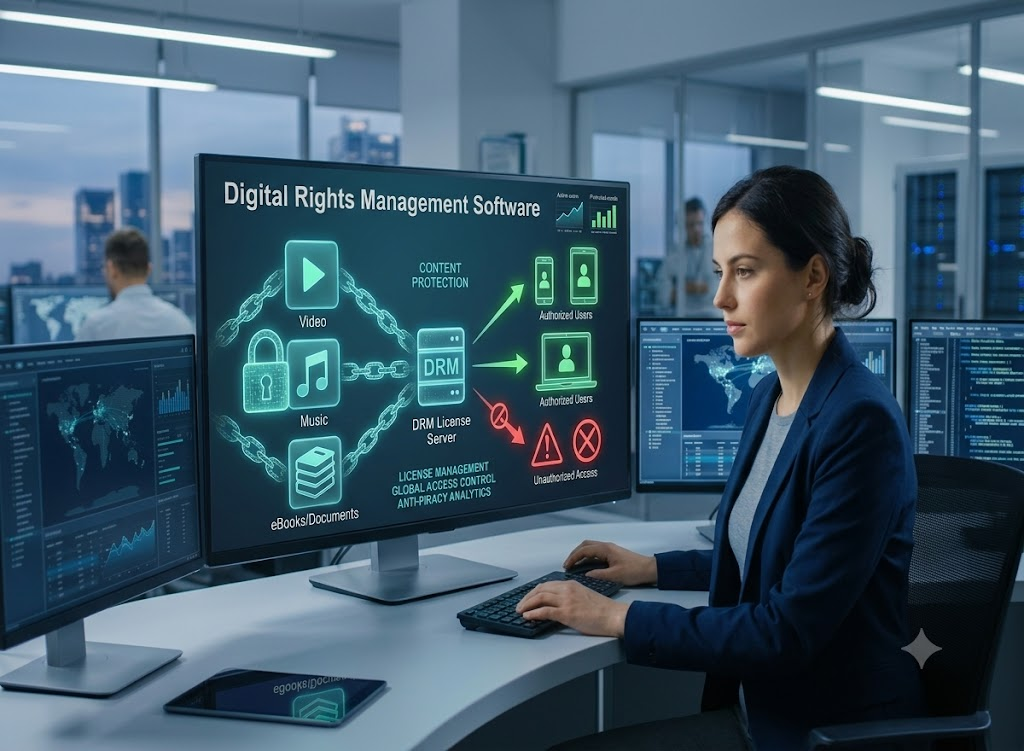
Digital rights management software is a specialized security technology used by content distributors and broadcasters to encrypt digital media, control user access, and prevent unauthorized copying or distribution of copyrighted assets. In the OTT industry, it ensures that only authenticated users with valid subscriptions or purchase tokens can decrypt and playback video content on specific devices.
Unlike basic password protection or standard video encryption (like HLS with AES-128), true digital rights management requires hardware-level integration on the user’s device and dynamic communication with a remote license server.
The Dual Perspective: Business and Technical
Understanding DRM requires looking at it through two distinct lenses: the revenue side and the engineering side.
The Business Perspective
From a commercial standpoint, digital rights management software is a revenue assurance tool.
Licensing Compliance: Major studios (e.g., Disney, Warner Bros) enforce strict security guidelines. Without a recognized DRM solution, platforms cannot legally distribute premium VOD (Video on Demand) content.
Monetization Protection: DRM prevents users from using screen-recording software or downloading streams to distribute on illegal torrent sites, safeguarding SVOD (Subscription) and TVOD (Transactional) revenue models.
Geographic Fencing: It enforces blackout rules for live sports. For instance, an English Premier League match licensed for the UAE cannot be legally streamed by your platform to a user in the USA.
The Technical Perspective
From a technical perspective, DRM is a cryptographic key exchange mechanism.
Asymmetric and Symmetric Encryption: The video file is encrypted once using a symmetric key. The symmetric key is then delivered to the user securely using asymmetric encryption.
Content Decryption Module (CDM): DRM relies on a secure hardware or software module built into the device’s operating system or browser (like the secure enclave in iOS).
License Servers: These servers handle the complex logic of checking user entitlements (e.g., “Does this user have a 4K subscription?”) before issuing the decryption key.
OTT Architecture Diagram: How DRM Works
(Note: Below is a descriptive breakdown of a standard Multi-DRM OTT workflow).
Ingest & Transcoding: The raw video file is ingested into enterprise Video Content Management Systems and transcoded into adaptive bitrate (ABR) formats (HLS/DASH).
Packaging & Encryption (The DRM Packager): The packager requests encryption keys from the Key Management System (KMS). The packager encrypts the video segments (using Common Encryption – CENC) and attaches metadata signaling which DRM systems are supported.
Storage & CDN Delivery: The encrypted video files are stored in an origin server and cached across a Content Delivery Network (CDN) for global distribution.
Client Request: The user clicks “Play” on their smart TV or mobile app. The video player downloads the manifest file and recognizes that the content is encrypted.
License Acquisition: The video player extracts the DRM metadata and sends a secure request (including a user authentication token) to the DRM License Server.
Decryption & Playback: The License Server validates the token via the platform’s backend. If valid, it issues a DRM license containing the decryption key and playback rules (e.g., “allow playback for 48 hours, block HDMI output”). The device’s secure CDM decrypts the video and renders it to the screen.
Regional Focus: Why the USA and UAE Demand Robust DRM
The United States Market
The US is the most mature and fragmented OTT market globally. With high Average Revenue Per User (ARPU), it is a primary target for sophisticated piracy rings.
Early Access Windows: Premium VOD releases (movies hitting streaming platforms shortly after theaters) require the highest tier of DRM hardware protection to prevent instant pirated 4K rips.
Complex Syndication: Content ownership in the US often involves complex, highly specific rights (e.g., mobile-only rights, out-of-market sports packages). DRM software dynamically enforces these granular rules.
The UAE and MENA Market
The UAE is a rapidly expanding hub for digital entertainment, driven by high smartphone penetration and massive investments in live sports.
Live Sports Piracy: The MENA region struggles significantly with illegal IPTV services rebroadcasting live sports (like cricket and football). Real-time DRM key rotation is critical here to disrupt illegal restreaming.
Regulatory Compliance: Telecommunications regulatory authorities in the UAE strictly monitor digital content distribution, making secure content delivery pipelines a compliance necessity.
Top Use Cases for Streaming Platforms
Live Sports Broadcasting: Utilizing dynamic key rotation to prevent unauthorized streams from staying alive longer than a few minutes.
Premium VOD Rentals: Enforcing time-bound licenses (e.g., the user has 30 days to start watching, and 48 hours to finish once started).
Offline Viewing: Allowing users to securely download episodes to their mobile devices for flights. The DRM software issues an offline license that self-destructs after a specified timeframe.
Tiered Subscriptions: Serving 1080p content to standard subscribers while restricting 4K HDR streams strictly to premium subscribers using hardware-level DRM checks.
Comparing Leading DRM Solutions
To achieve cross-platform compatibility across modern OTT app development projects, OTT architects must implement a Multi-DRM strategy, integrating the “Big Three” providers.
Feature / System
Google Widevine
Apple FairPlay
Microsoft PlayReady
Primary Ecosystem
Android, Chrome, Android TV, Chromecast
iOS, macOS, Safari, Apple TV
Windows, Edge, Xbox, Smart TVs
Streaming Protocol
MPEG-DASH, HLS
HLS
MPEG-DASH, Smooth Streaming
Hardware Security
Level 1 (Hardware), Level 3 (Software)
Hardware-backed secure enclave
SL3000 (Hardware), SL2000 (Software)
Best For
Mobile apps (Android) and web streaming.
Premium content on Apple devices.
Gaming consoles and Windows PCs.
Pros and Cons of Implementation
Pros
Unlocks Premium Content: Satisfies the strict security audits required by Hollywood and major sports leagues.
Granular Control: Allows platforms to enforce specific rules regarding resolution, output (blocking screen capture), and rental windows.
Revenue Protection: Drastically reduces casual piracy and credential sharing, directly impacting the bottom line.
Latency Issues: Poorly optimized license server requests can delay video startup time (Time to First Frame), frustrating users.
Cost: Enterprise DRM solutions and managed Multi-DRM services incur monthly licensing and usage fees.
Architect Best Practices and Expert Tips
Expert Insight:
“Do not attempt to build a DRM license server from scratch. The cryptographic complexity and maintenance of keeping up with browser and OS updates are immense. Instead, leverage a managed Multi-DRM provider or consult with specialized technology partners like ARYtech or platforms like Vodistryto focus your engineering efforts on your frontend player integration and backend entitlement logic.”
Best Practices for Deployment
Use Common Encryption (CENC): Encrypt your media files once using CENC. This allows you to use a single encrypted video file alongside multiple DRM systems, drastically reducing your storage and CDN costs.
Implement Forensic Watermarking: DRM stops unauthorized playback, but it cannot stop someone from recording their TV screen with a camera. Pair DRM with dynamic forensic watermarking to trace leaked videos back to the specific user account.
Optimize License Delivery: Pre-fetch DRM licenses during the app loading phase or while the user is browsing the catalog to ensure instant playback when they click play.
Frequently Asked Questions (FAQs)
1. What is digital rights management software in simple terms?
It is a security lock placed on digital video files. Only users who have the correct “key” (granted by logging in and paying for a subscription) can open and watch the video.
2. Can I use standard AES encryption instead of DRM?
Standard AES-128 encryption (Clear Key) hides the video, but the decryption key is sent in plain text to the browser. Anyone with basic developer tools can find the key and steal the video. DRM hides the key inside secure hardware.
3. Does DRM slow down video streaming?
If configured incorrectly, the time it takes to request and receive the DRM license can add a few hundred milliseconds to the startup time. However, optimized platforms use license pre-fetching so the user notices zero delay.
4. Why do I need a Multi-DRM setup?
Because Apple devices only support FairPlay, Android/Chrome devices rely on Widevine, and Windows devices prefer PlayReady. To reach all users, your platform must support all three simultaneously.
5. How much does digital rights management software cost?
Costs vary based on the vendor and usage scale. Typically, managed Multi-DRM providers charge a setup fee and a fraction of a cent per issued license, scaling with your active user base.
6. Can DRM stop screen recording?
Yes. Hardware-level DRM (like Widevine L1 or PlayReady SL3000) prevents the operating system’s screen capture APIs from accessing the decrypted video frames, resulting in a black screen if a user tries to record.
7. Does DRM work for offline downloads?
Yes. Modern DRM systems support persistent licenses. The OTT app securely downloads the encrypted video and a time-bound DRM license, allowing the user to watch offline until the license expires.
8. What happens when a DRM system updates?
Managed DRM vendors handle the backend updates. However, OTT platform developers must ensure their video player SDKs are regularly updated to maintain compatibility with the latest browser and OS security patches.
Conclusion
Building a successful streaming platform in highly competitive markets like the USA and UAE requires more than just a great content library and a sleek user interface. It requires an ironclad commitment to content security.
Understanding what digital rights management software is and how to architect it seamlessly into your streaming pipeline is the difference between a profitable enterprise OTT business and one crippled by piracy and licensing lawsuits. By adopting a Multi-DRM approach, utilizing Common Encryption, and following stringent backend entitlement protocols, platforms can protect their revenue while delivering flawless viewing experiences to their users.
Ready to secure your streaming infrastructure?
Our team of OTT Solution Architects specializes in integrating enterprise-grade Multi-DRM systems, custom video players, and high-performance backend infrastructures. Contact ARYtech today to audit your current platform security or to start building a studio-compliant streaming service from the ground up.
Dubai’s transformation into a global powerhouse for artificial intelligence is no longer just a vision it is an operational reality. Driven by government initiatives like the Dubai Universal Blueprint for Artificial Intelligence (DUB.AI) and regulated by bodies such as the Saudi Data and Artificial Intelligence Authority (SDAIA) and the UAE’s AI, Digital Economy, and Remote Work Applications Office, the emirate has established a business-friendly environment for technological innovation.
For tech leaders, digital product managers, and enterprise architects, partnering with the right AI companies in Dubai is essential to executing a successful digital roadmap. Whether you need to deploy an in-Kingdom Retrieval-Augmented Generation (RAG) system, automate complex supply chain logistics, or integrate custom machine learning algorithms into your enterprise stack, choosing the ideal software engineering firm requires navigating real-world technical trade-offs, compliance mandates, and budgetary expectations.
This comprehensive guide breaks down the top AI companies in Dubai, examining their technical capabilities, pricing models, architectural frameworks, and implementation best practices to help you make an informed vendor decision.
The State of Enterprise AI in Dubai
Dubai’s AI ecosystem operates at the intersection of public-sector policy and private-sector investment. Driven by government mandates like the UAE National Strategy for Artificial Intelligence 2031, the region prioritizes local data residency, bilingual Arabic-English Large Language Models (LLMs), and autonomous agentic workflows.
Enterprise AI implementations in the UAE have matured beyond basic conversational wrappers or simple text generators. Organizations are actively building custom machine learning models, deploying computer vision systems for smart city infrastructure, and integrating predictive analytics into legacy ERP platforms.
When building this infrastructure, tech leaders must partner with experienced software developers who specialize in ai development services that comply with strict regional data sovereignty and privacy standards.
How We Evaluated the Leading AI Vendors
To provide a clear, unbiased recommendation, our engineering panel evaluated dozens of local and international AI agencies operating in the United Arab Emirates. Each provider was assessed across five core parameters:
Custom AI & ML Depth: Ability to build, fine-tune, and deploy bespoke machine learning models rather than simply wrapping public APIs.
Arabic NLP Capabilities: Native support for Arabic Natural Language Processing, dialect recognition, and localized data processing.
Enterprise System Integration: Proven track record of integrating AI microservices into legacy enterprise platforms (SAP, Oracle, Salesforce).
Data Security & Sovereign Compliance: Strict adherence to UAE Federal Decree-Law No. 45 on Personal Data Protection (PDPL) and local data residency rules.
Cost Transparency & ROI Delivery: Fair pricing models, clear milestone structures, and a history of delivering measurable business outcomes.
Top AI Companies in Dubai: Comparative Breakdown
Evaluating specialized software providers requires looking at both local market reputation and technical engineering capabilities. The table below offers a high-level comparison of the leading AI companies in Dubai:
Custom AI Engineering, Enterprise RAG, Agentic Workflows
Mid-Market & Enterprise
AED 40,000 – AED 250,000+
Localized Arabic NLP, custom model building, low-latency integration.
Code Brew Labs
Generative AI SaaS, Enterprise Workflows, Mobile AI Integration
Startups & Mid-Market
AED 35,000 – AED 150,000
Fast prototyping, custom UI/UX, scalable AI mobile apps.
Simform
Custom Software, Cloud AI Deployments, System Integrations
Enterprise & Global Brands
AED 50,000 – AED 300,000+
Large engineering teams, MLOps, cloud infrastructure.
Blink22
Web/Mobile AI Tools, Natural Language Processing, Custom APIs
Startups & Scaleups
AED 30,000 – AED 120,000
Agile delivery, clean API engineering, UI/UX polish.
ELEKS
Enterprise Digital Transformation, Custom ML, Big Data
Enterprise & Public Sector
AED 100,000 – AED 500,000+
R&D capabilities, deep data science, heavy industrial AI.
Key Market Players Analyzed
1. Arytech
Overview:Arytech has established itself as a premier technical partner for organizations across the Middle East seeking custom ai development services tailored to regional business needs. The company focuses heavily on custom model training, enterprise-grade Retrieval-Augmented Generation (RAG), and sovereign AI deployments.
Core AI Services: Custom LLM fine-tuning, Agentic workflow automation, bilingual Arabic-English NLP, predictive analytics engines, and enterprise data lake engineering.
Key Benefits: High data privacy compliance (PDPL-ready), zero reliance on generic black-box APIs, and direct integration into existing enterprise platforms.
Estimated Cost Range: AED 40,000 for focused AI automation modules up to AED 250,000+ for full-scale enterprise AI deployments.
2. Code Brew Labs
Overview: A well-known tech agency operating across Dubai, Code Brew Labs offers digital product development with a dedicated focus on custom AI SaaS platform builds and generative AI integrations.
Core AI Services: Custom AI SaaS platform development, NLP-powered service automation, and predictive recommendation systems.
Key Benefits: Competitive pricing models, rapid MVP rollouts, and strong mobile application interface design.
Estimated Cost Range: AED 35,000 – AED 150,000.
3. Simform
Overview: Operating globally with a strong presence in the UAE market, Simform assists mid-market companies and large enterprises in modernizing their digital infrastructure through cloud-native AI integrations.
Core AI Services: MLOps lifecycle management, custom computer vision solutions, and cloud data architecture engineering.
Key Benefits: Dedicated engineering teams, strong communication practices, and deep experience across regulated industries.
Estimated Cost Range: AED 50,000 – AED 300,000+.
4. Blink22
Overview: Blink22 focuses heavily on building custom web and mobile software platforms, incorporating intelligent features like predictive search, NLP chatbots, and automated workflows for digital-first businesses.
Core AI Services: Custom API development, conversational AI interfaces, and light-weight machine learning model integrations.
Key Benefits: Transparent communication, agile sprint methodologies, and polished user interface design.
Estimated Cost Range: AED 30,000 – AED 120,000.
5. ELEKS
Overview: ELEKS delivers complex data science, machine learning, and enterprise digital transformation services for large corporations and public-sector entities.
Core AI Services: Custom R&D data science, deep neural network engineering, and industrial-scale predictive maintenance models.
Key Benefits: Massive engineering capacity, rigorous quality assurance, and deep mathematical modeling expertise.
Estimated Cost Range: AED 100,000 – AED 500,000+.
Enterprise AI System Architecture: A Technical Overview
Deploying an enterprise-grade AI system requires a modular, maintainable software design. Below is a technical description of a modern, multi-tier Retrieval-Augmented Generation (RAG) and Agentic Workflow architecture:
Data Ingestion & Cleaning Layer: Automated ETL pipelines pull unstructured data (PDFs, contracts, support tickets) and structured tables (SQL, ERP records). The data is tokenized, sanitized of sensitive personal information (PII), and processed.
Vector Embedding & Storage Fabric: Cleaned data is passed through high-performance embedding models (such as localized bilingual models) to generate mathematical vectors. These vectors are indexed inside a secure vector database (e.g., Qdrant, Pinecone, or self-hosted PostgreSQL pgvector) hosted within local UAE cloud regions.
Contextual Retrieval Engine: When a user or system initiates a query, the retrieval layer searches the vector database using semantic similarity matching. It retrieves the top relevant context blocks while adhering to strict user role-based access controls (RBAC).
Model Orchestration & Guardrails Layer: The retrieved context is combined with the original query and sent to an orchestrated model mesh (using frameworks like LangChain or LlamaIndex). An automated guardrail engine screens incoming and outgoing prompts for compliance, privacy leaks, and hallucination risks.
Agentic Execution & API Gateway: The AI model does not just return text; it can execute multi-step actions (calling internal microservices, updating CRM records, or generating automated invoices) via secure RESTful APIs and webhooks.
Cost & Investment Frameworks for AI Projects in the UAE
AI software pricing in Dubai depends on technical complexity, data readiness, integration density, and hosting requirements. The tables below outline realistic financial benchmarks for regional projects:
1. Overall Implementation Cost Breakdown
AI Project Tier
Scope & Deliverables
Build Cost (AED)
Annual Maintenance (20–35%)
Proof of Concept (PoC)
Data readiness audit, single-silo RAG test, basic UI sandbox.
AED 15,000 – AED 35,000
AED 5,000 – AED 10,000
Focused AI Module
Custom NLP agent, specialized workflow bot, API middleware.
AED 35,000 – AED 85,000
AED 10,000 – AED 25,000
Enterprise AI System
Multi-source data pipeline, Agentic execution, legacy ERP integration.
AED 90,000 – AED 250,000
AED 25,000 – AED 70,000
Sovereign Platform
Custom model fine-tuning, on-prem hardware deployment, MLOps suite.
AED 300,000 – AED 750,000+
AED 70,000 – AED 180,000+
2. Specific Service Pricing Benchmarks in Dubai
AI Service Category
Core Features Included
Typical UAE Price Range (AED)
Enterprise AI Chatbot / RAG
Bilingual Arabic/English, CRM sync, WhatsApp & Web channel integration.
AED 30,000 – AED 80,000
AI Video Analytics
Computer vision engine, 15–30 camera streams, automated alerting.
Commercial organizations in Dubai leverage AI development services to solve complex operational challenges:
1. Financial Services & FinTech
Use Case: Automated Anti-Money Laundering (AML) and fraud detection.
Impact: Real-time analysis of transaction streams flags suspicious patterns instantly, reducing manual auditing workloads by up to 70% while satisfying Central Bank of the UAE regulatory standards.
2. Real Estate & PropTech
Use Case: Automated property valuation engines and intelligent lead routing.
Impact: Computer vision networks analyze property images and market historical trends to estimate rental yields, while localized conversational agents qualify incoming buyer inquiries 24/7.
3. Supply Chain & Smart Logistics
Use Case: Predictive demand forecasting and automated fleet routing.
Impact: Machine learning algorithms evaluate port congestion data, regional weather patterns, and historical order volumes to minimize fuel consumption and reduce delivery delays.
Pros & Cons of Onshore vs. Offshore AI Vendors
When contracting AI companies in Dubai, technology leaders often choose between fully local (onshore) engineering firms and remote offshore teams.
┌─────────────────────────────────────────────────────────────────┐
│               Onshore vs. Offshore Vendor Trade-offs             │
├─────────────────────────────────────────────────────────────────┤
│ ONSHORE (Dubai-based)                                           │
│  ✔ On-site collaboration & direct accountability                 │
│  ✔ Full understanding of UAE PDPL compliance laws               │
│  ✖ Higher development retainer costs                            │
├─────────────────────────────────────────────────────────────────┤
│ OFFSHORE / HYBRID                                               │
│  ✔ Lower initial hourly build rates                             │
│  ✖ Communication friction & potential data transfer risks       │
│  ✖ Reduced context on regional Arabic linguistic nuances       │
└─────────────────────────────────────────────────────────────────┘
Expert Tips for Selecting an AI Partner
Expert Insight:“Never select an AI vendor based solely on an impressive front-end demo. Most basic demos rely on unconstrained public APIs that fail under real enterprise load. Always ask prospective partners to show their error handling, data privacy safeguards, and MLOps maintenance frameworks.”
Demand Architecture Transparency: Ask the vendor to provide a complete diagram showing where data travels, how vector embeddings are generated, and where hosting servers sit.
Prioritize Modular, Framework-Agnostic Code: Ensure your application is built on flexible frameworks (e.g., PyTorch, LangChain, LlamaIndex) rather than locked into a single proprietary LLM provider.
Request a Paid Proof of Concept (PoC): Before committing to a six-figure custom software contract, commission a 4-week PoC to test the vendor’s code quality and delivery speed.
Inquire About Arabic NLP Fine-Tuning: Ensure the engineering team has experience handling the specific Arabic dialects relevant to your target demographic in the GCC.
Frequently Asked Questions (FAQs)
1. Why should my enterprise hire local AI companies in Dubai rather than using offshore agencies?
Hiring local AI companies in Dubai ensures your development team understands regional data privacy regulations (such as UAE Federal Decree-Law No. 45), guarantees local data hosting compliance, and provides native understanding of Arabic linguistic nuances.
2. How much does a typical custom AI project cost in Dubai?
A focused AI module or intelligent chatbot build generally ranges between AED 30,000 and AED 85,000. Complex enterprise-wide platforms featuring custom integrations and MLOps frameworks typically range from AED 90,000 to AED 250,000+.
3. How long does it take to develop and deploy an AI solution in the UAE?
A basic Proof of Concept (PoC) takes 3 to 5 weeks. A fully functional mid-complexity AI application takes 8 to 12 weeks, while enterprise-scale platforms require 4 to 6 months of development, testing, and compliance auditing.
4. What is the difference between a custom AI build and wrapping a public API?
Wrapping a public API simply routes your prompt to an external server like OpenAI without custom data grounding. A custom AI build involves engineering a secure data pipeline, constructing an in-house vector database, deploying guardrails, and fine-tuning models specifically on your private corporate data.
5. How do AI solutions in Dubai ensure compliance with local PDPL data laws?
Compliance is achieved by deploying AI workloads inside localized UAE cloud regions (such as AWS Middle East or Azure UAE) or on-premises micro-datacenters, encrypting data both in transit (TLS 1.3) and at rest (AES-256), and implementing strict role-based access controls.
6. Can an AI application integrate with our legacy ERP software?
Yes. Professional AI engineering agencies build custom API connectors and microservices that act as translation bridges between modern machine learning systems and legacy databases (e.g., SAP, Oracle, SQL mainframes).
7. What ongoing costs should businesses budget for after launch?
Organizations should budget 20% to 35% of the initial build cost annually to cover cloud hosting, API token consumption, continuous security patching, model drift monitoring, and maintenance.
Conclusion & Strategic Next Steps
Building a successful artificial intelligence capability in the United Arab Emirates requires balancing technical ambition with data security, compliance mandates, and clear ROI metrics. Partnering with the right software development agency ensures your enterprise can deploy scalable, future-proof AI systems without accumulating technical debt.
If you are ready to evaluate your organization’s AI readiness, build a custom proof of concept, or explore production-grade machine learning pipelines, consult with verified engineering specialists at Arytech today.
The explosion of streaming services has transformed how audiences consume video. Whether it’s a global media company launching a subscription platform, a broadcaster expanding into digital channels, or an enterprise delivering internal training, video has become the primary medium for engaging users. Behind every seamless streaming experience, however, lies a sophisticated system responsible for organizing, processing, publishing, and distributing thousands or even millions of video assets.
This is where Video Content Management Systems become indispensable.
Unlike traditional content management systems, a modern video content management platform is purpose-built to manage the complete lifecycle of video content from ingestion and metadata management to transcoding, digital rights management (DRM), analytics, and multi-device publishing. For OTT businesses, it serves as the operational backbone that enables efficient workflows, faster content delivery, and scalable streaming experiences.
As streaming audiences grow across the United States and the United Arab Emirates, organizations are under increasing pressure to launch content quickly, maintain consistent quality, and support multiple monetization models such as SVOD, AVOD, TVOD, and FAST channels. Without a centralized video content management solution, these goals become difficult to achieve.
This guide explains how enterprise-grade Video Content Management Systems work, their core architecture, business benefits, essential features, implementation best practices, and how they support modern OTT platform development. Whether you’re planning a new streaming service or modernizing an existing media ecosystem, this article will help you make informed technology decisions.
What Is a Video Content Management System?
A Video Content Management System (VCMS) is specialized software that enables organizations to store, organize, process, manage, publish, and distribute video assets from a centralized platform.
Unlike a website CMS that primarily manages text and images, a Video CMS is designed specifically for handling large media files, complex workflows, multiple video formats, metadata, transcoding, user permissions, and streaming delivery.
It acts as the central hub connecting content creators, editors, administrators, OTT applications, CDNs, analytics platforms, and end users.
In simple terms:
A Video CMS manages everything that happens before a viewer presses Play.
What Does a Video Content Management Platform Do?
An enterprise-grade video content management platform typically handles:
Video ingestion
Asset organization
Metadata management
Automated transcoding
Thumbnail generation
Subtitle management
DRM integration
Multi-language support
Content scheduling
User permissions
API integrations
Analytics
Multi-device publishing
CDN delivery
These capabilities allow media organizations to automate repetitive tasks while ensuring content remains secure, searchable, and accessible across multiple devices.
What is a Video Content Management System?
A Video Content Management System (VCMS) is enterprise software that manages the complete lifecycle of video assets, including ingestion, storage, metadata, transcoding, publishing, security, and distribution across OTT platforms, websites, mobile apps, and smart TVs.
Why OTT Businesses Need a Video Content Management Platform
Modern OTT platforms process thousands of content updates every month. Managing this manually quickly becomes inefficient and error-prone.
An enterprise video content management solution provides a centralized environment where content teams, developers, and business stakeholders collaborate without disrupting operational workflows.
Key business challenges solved by Video CMS
Large-scale media libraries
Content version control
Publishing delays
Metadata inconsistencies
Multi-device distribution
Regional content availability
Rights management
Security and compliance
Workflow automation
Without a centralized system, teams often rely on disconnected tools, resulting in duplicated work, inconsistent metadata, slower publishing, and increased operational costs.
Business Benefits
Challenge
Video CMS Solution
Large media libraries
Centralized asset management
Slow publishing
Automated workflows
Multiple OTT apps
Single publishing source
Security concerns
DRM and access control
Manual processing
Automated transcoding
Poor discoverability
AI-powered metadata
Expert Insight
Enterprise OTT platforms should view their Video CMS as a strategic business platform rather than simply a storage repository. The more intelligently content is organized and automated, the easier it becomes to launch new services, improve viewer engagement, and scale operations without significantly increasing operational costs.
How Video Content Management Systems Work
Understanding the workflow behind Video Content Management Systems helps organizations evaluate which platform best aligns with their technical and business requirements.
Although implementations differ, most enterprise platforms follow a similar processing pipeline.
Step 1: Content Ingestion
Content enters the platform through various sources:
Production studios
Live broadcasts
Mobile applications
Partner uploads
Cloud storage
FTP servers
API integrations
Supported formats commonly include:
MP4
MOV
MKV
AVI
MXF
ProRes
During ingestion, the system validates files and prepares them for processing.
Step 2: Metadata Management
Metadata transforms a video library into a searchable, organized content ecosystem.
Typical metadata includes:
Title
Description
Genre
Language
Cast
Director
Season
Episode
Keywords
Release date
Age rating
Rights information
Geographic availability
Modern platforms increasingly use AI to automate metadata generation through speech recognition, object detection, and facial recognition.
Step 3: Video Processing
Uploaded videos are processed into streaming-ready formats.
This typically includes:
Video transcoding
Resolution optimization
Adaptive bitrate encoding
Thumbnail creation
Subtitle generation
Audio normalization
Caption synchronization
Multiple versions are created for different devices and network conditions to ensure a consistent viewing experience.
Step 4: Content Publishing
Once processing is complete, administrators can publish content across multiple channels, including:
OTT mobile apps
Smart TV applications
Web platforms
Android TV
Apple TV
Fire TV
Roku
Samsung TV
LG TV
A single publishing workflow significantly reduces operational complexity and improves time-to-market.
Step 5: Content Delivery
The published content is delivered through a Content Delivery Network (CDN), which caches media closer to end users to reduce latency and improve playback performance.
This ensures:
Faster video startup times
Reduced buffering
High availability
Better global performance
Core Components of a Video Content Management Solution
Every enterprise video content management solution consists of multiple integrated components that work together to support content operations.
1. Media Asset Repository
The centralized storage layer where all video files, images, subtitles, and related assets are securely stored and managed.
2. Metadata Engine
Responsible for indexing and organizing content using structured metadata, enabling powerful search, filtering, and personalized recommendations.
3. Transcoding Engine
Converts source files into multiple streaming formats and resolutions compatible with different devices and network conditions.
Common output formats include:
HLS
MPEG-DASH
MP4
4. Digital Rights Management (DRM)
Protects premium content from unauthorized access and piracy through encryption and license management.
Common DRM technologies include:
Google Widevine
Apple FairPlay
Microsoft PlayReady
5. Content Scheduling Module
Allows administrators to:
Coordinate live events
Schedule releases
Set expiration dates
Manage regional availability
Publish seasonal campaigns
As organizations evaluate enterprise streaming technologies, they should also understand the broader role of an OTT platform development company in building scalable ecosystems that integrate content management, streaming infrastructure, monetization, analytics, and user experience.
For businesses planning mobile-first streaming experiences, exploring OTT app development considerations early in the project lifecycle helps ensure seamless integration between the application layer and the underlying Video CMS.
Similarly, organizations looking to accelerate deployment can assess White Label OTT Solutions that include a built-in Video CMS, reducing development time while retaining branding flexibility.
Core Features Every Enterprise Video Content Management System Should Include
Selecting a Video Content Management System is not simply about choosing software to store videos. Enterprise organizations require a platform capable of managing complex workflows, supporting millions of users, integrating with existing systems, and adapting to future business growth.
Below are the essential capabilities every enterprise-grade video content management platform should offer.
1. Centralized Content Library
As content libraries expand, manually organizing media assets becomes increasingly difficult. A centralized repository enables teams to manage videos from a single interface.
Benefits include:
Faster content discovery
Simplified asset organization
Elimination of duplicate files
Consistent content taxonomy
Improved collaboration across departments
2. Advanced Metadata Management
Metadata is the foundation of content discoverability.
Beyond titles and descriptions, enterprise platforms should support:
Categories
Genres
Cast and crew
Language variants
Geo-restrictions
Copyright information
Licensing dates
SEO metadata
Custom metadata fields
Well-structured metadata also improves content recommendations and personalized viewing experiences.
3. AI-Powered Content Tagging
Modern OTT businesses increasingly rely on artificial intelligence to automate content management.
AI capabilities may include:
Speech-to-text transcription
Scene detection
Facial recognition
Logo recognition
Object detection
Automatic keyword generation
Content moderation
This reduces manual effort while improving search accuracy across large video libraries.
4. Workflow Automation
Manual publishing slows operations and increases the likelihood of errors.
A robust video content management solution should automate repetitive tasks such as the following:
Encoding
Thumbnail generation
Subtitle creation
Metadata enrichment
Publishing approvals
Content scheduling
Archive management
Automation allows content teams to focus on programming rather than repetitive operational work.
5. Multi-Platform Publishing
Today’s viewers consume content across numerous devices.
A single publishing workflow should support:
Web
Android
iOS
Android TV
Apple TV
Roku
Amazon Fire TV
Samsung Smart TV
LG webOS
Gaming consoles
Publishing once and distributing everywhere significantly improves operational efficiency.
6. Enterprise Security
Content protection remains a top priority for broadcasters and premium OTT providers.
Key security capabilities include:
DRM integration
Token authentication
Role-based access control
Multi-factor authentication
Audit logs
Secure API authentication
IP restrictions
Encryption at rest and in transit
7. Analytics and Reporting
Business decisions should be driven by data.
Enterprise analytics should provide visibility into:
Most viewed content
Viewer engagement
Watch time
Drop-off points
Device distribution
Geographic performance
Subscriber behavior
Revenue performance
These insights help optimize both content strategy and platform performance.
Traditional CMS vs Video Content Management Systems
Although both systems manage digital content, their objectives are fundamentally different.
Feature
Traditional CMS
Video Content Management System
Primary Content
Text & Images
Video Assets
Video Encoding
No
Yes
Adaptive Streaming
No
Yes
DRM Support
Limited
Built-in
Metadata Management
Basic
Advanced
Multi-Device Publishing
Limited
Enterprise Ready
CDN Integration
Basic
Native
OTT Support
No
Yes
Video Analytics
Limited
Comprehensive
Scalability
Moderate
Enterprise Scale
For organizations operating streaming platforms, a dedicated video content management platform provides capabilities that a traditional CMS cannot deliver.
Enterprise OTT Architecture (Diagram Description)
Suggested Architecture Diagram
Content Sources
        │
        ▼
Video Ingestion Layer
        │
        ▼
Media Storage
        │
        ▼
Metadata Engine
        │
        ▼
Transcoding Pipeline
        │
        ▼
DRM & Security
        │
        ▼
Video CMS Dashboard
        │
 ┌──────┼────────┐
 ▼      ▼        ▼
Mobile  Smart TV Web Portal
        │
        ▼
Content Delivery Network (CDN)
        │
        ▼
End Users
This architecture separates ingestion, processing, management, and delivery into scalable services, making it easier to expand as content volume and user demand increase.
Real-World Use Cases
1. Media & Broadcasting
Television networks manage thousands of episodes, trailers, and promotional videos.
A centralized Video CMS enables:
Faster publishing
Regional scheduling
Metadata consistency
Rights management
Live event coordination
2. Sports Streaming
Sports broadcasters handle live matches, highlights, interviews, and replays.
A Video CMS helps by:
Automatically clipping highlights
Publishing instant replays
Managing multilingual commentary
Scheduling live events
Organizing seasonal archives
3. Education Platforms
Universities and online learning providers require structured video libraries.
Benefits include:
Course organization
Secure student access
Subtitle management
Learning analytics
Multi-device access
4. Corporate Training
Large enterprises increasingly rely on video for employee education.
Typical use cases include:
Compliance training
Product education
Onboarding
Leadership communication
Internal knowledge sharing
5. Religious & Community Streaming
Faith-based organizations can stream sermons, lectures, and live events while organizing content by speaker, topic, language, or event. Features like multilingual subtitles, scheduled publishing, and secure archives make content easier to access for global audiences.
Best Practices for Implementing a Video Content Management Solution
A successful implementation depends on planning, governance, and scalability—not just software selection.
Build a Metadata Strategy
Define naming conventions and standardized metadata before migrating content. Consistent metadata improves search, recommendations, and reporting.
Design for Scalability
Plan infrastructure that can handle future growth in:
Users
Video uploads
Live events
Storage
Global traffic
Cloud-native architectures often provide greater flexibility than fixed on-premises deployments.
Automate Wherever Possible
Reduce manual effort through automation:
Encoding
Publishing
Scheduling
Notifications
Quality checks
Archiving
Automation improves consistency and accelerates operations.
Secure Premium Content
Implement:
DRM
Secure authentication
Access permissions
Encryption
Continuous security monitoring
Protecting intellectual property is essential for subscription-based and premium content providers.
Monitor Performance Continuously
Track operational metrics such as:
Processing times
Encoding success rates
Storage usage
CDN performance
Playback quality
Viewer engagement
Continuous monitoring helps identify bottlenecks before they affect the user experience.
Pros and Cons of Enterprise Video Content Management Systems
Pros
Cons
Centralized video management
Higher initial implementation effort
Faster publishing workflows
Requires user training
Improved collaboration
Integration planning is essential
Enhanced security
Enterprise platforms involve ongoing maintenance
Scalable architecture
Customization may increase project complexity
Better analytics
Migration from legacy systems can take time
Expert Insight
Organizations often focus on selecting the right platform but underestimate the importance of governance. Establish clear content ownership, metadata standards, approval workflows, and retention policies before deployment. A well-governed Video CMS delivers long-term operational efficiency and makes future scaling significantly easier.
As your streaming ecosystem grows, your Video CMS should integrate seamlessly with a broader OTT platform development company strategy that includes user management, monetization, analytics, and content delivery.
Businesses launching new streaming services can also benefit from understanding the latest trends in OTT app development, ensuring that mobile, web, and connected TV applications work cohesively with the backend content platform.
If speed to market is a priority, evaluating White Label OTT Solutions can help accelerate deployment while still providing enterprise-grade content management capabilities.
How to Choose the Right Video Content Management System
Not every Video CMS is designed for enterprise OTT operations. Before selecting a platform, organizations should evaluate both current requirements and long-term business objectives.
Ask These Questions Before Investing
Can the platform scale to millions of viewers?
Does it support live and on-demand streaming?
Is it cloud-native or limited to on-premises deployment?
Does it integrate with existing OTT applications and APIs?
Can it support multiple monetization models such as SVOD, AVOD, TVOD, and FAST?
Does it include AI-powered metadata management?
What security features are available?
Can non-technical teams manage content independently?
Does it support multilingual content and regional publishing?
How flexible is the reporting and analytics module?
Selecting a platform based only on current needs may lead to expensive migrations in the future. Enterprise organizations should choose a solution that supports long-term growth.
Enterprise Implementation Roadmap
A successful implementation requires more than installing software. It involves aligning technology, workflows, governance, and business objectives.
Phase
Activities
Outcome
Discovery
Business requirements, stakeholder workshops, content audit
Many organizations invest in a Video CMS but fail to achieve the expected return because they overlook operational planning.
Avoid these common mistakes:
Choosing a platform based only on price
Ignoring scalability requirements
Using inconsistent metadata across departments
Delaying security implementation
Skipping user training
Building workflows without automation
Selecting a system with limited API capabilities
Not planning for global content distribution
Failing to monitor performance after deployment
Addressing these issues early helps reduce operational costs and accelerates time-to-market.
Future Trends in Video Content Management Systems
The next generation of Video Content Management Systems is becoming more intelligent, automated, and data-driven.
Key trends include:
AI-Assisted Content Operations
Artificial intelligence is streamlining media workflows by automatically generating metadata, creating subtitles, detecting scenes, recommending tags, and improving content discoverability.
Cloud-Native Infrastructure
Cloud-first platforms provide greater scalability, faster deployments, improved disaster recovery, and lower infrastructure maintenance compared to traditional on-premises solutions.
Hyper-Personalized Viewer Experiences
Advanced analytics and recommendation engines allow OTT providers to deliver personalized content based on viewing behavior, increasing engagement and retention.
Headless Video CMS
Headless architectures separate the content management backend from the presentation layer, enabling organizations to publish content consistently across web, mobile, smart TVs, and emerging digital channels through APIs.
Automation Across the Content Lifecycle
Automation is reducing manual effort across ingestion, transcoding, scheduling, publishing, rights management, and archive workflows, allowing media teams to focus on content strategy rather than repetitive operational tasks.
Expert Tips for Enterprise OTT Platforms
Organizations planning long-term growth should consider the following recommendations:
Build a scalable metadata strategy before uploading content.
Choose API-first platforms to simplify integrations.
Automate repetitive workflows wherever possible.
Implement DRM and access controls from day one.
Use cloud storage for greater flexibility and resilience.
Monitor viewer analytics continuously to improve engagement.
Regularly review content performance and archive low-value assets.
Establish governance policies for metadata, publishing, and user permissions.
Select a Video CMS that supports future business models and emerging technologies.
Frequently Asked Questions
What is a Video Content Management System?
A Video Content Management System is software that manages the complete lifecycle of video assets, including ingestion, storage, metadata management, transcoding, publishing, security, analytics, and distribution across OTT platforms and digital channels.
How is a Video Content Management Platform different from a traditional CMS?
A traditional CMS focuses on managing webpages, text, and images, while a video content management platform is designed specifically for video workflows, including encoding, DRM, adaptive streaming, metadata management, and multi-device publishing.
Why do OTT businesses need a Video Content Management Solution?
A centralized video content management solution simplifies content operations, automates workflows, improves collaboration, enhances security, and enables faster publishing across multiple streaming platforms.
Can a Video CMS support live streaming?
Yes. Most enterprise platforms support both live and video-on-demand (VOD) workflows, including live event scheduling, recording, clipping, and replay management.
Is cloud deployment better than on-premises deployment?
Cloud deployment offers greater scalability, reduced infrastructure maintenance, global availability, and faster deployments. However, organizations with strict regulatory requirements may prefer hybrid or on-premises architectures.
What security features should a Video CMS include?
Enterprise platforms should provide DRM integration, encryption, role-based access control, audit logging, secure APIs, token authentication, and multi-factor authentication to protect valuable media assets.
Can AI improve Video Content Management?
Yes. AI can automate metadata generation, speech transcription, subtitle creation, object recognition, content moderation, and personalized recommendations, significantly improving operational efficiency.
What industries benefit from Video Content Management Systems?
Industries including media and entertainment, sports, education, corporate training, healthcare, government, telecom, and faith-based organizations benefit from centralized video management and scalable streaming workflows.
Conclusion
As streaming ecosystems become increasingly complex, Video Content Management Systems have evolved from simple media repositories into mission-critical platforms that power modern OTT businesses. From content ingestion and metadata management to security, analytics, and multi-device publishing, an enterprise-grade video content management platform enables organizations to deliver high-quality viewing experiences while maintaining operational efficiency.
Whether you’re launching a new OTT service, expanding into global markets, or modernizing an existing streaming infrastructure, investing in the right video content management solution can reduce operational overhead, improve collaboration, strengthen security, and accelerate content delivery.
For organizations seeking a scalable and future-ready OTT ecosystem, partnering with an experienced OTT platform development company is just as important as selecting the right technology. A strategic implementation ensures that your Video CMS integrates seamlessly with streaming applications, monetization systems, analytics, content delivery networks, and business workflows.
Ready to Build a Scalable OTT Platform?
Whether you’re developing a subscription streaming service, launching a corporate video portal, or modernizing an enterprise media ecosystem, ARYtech provides end-to-end OTT platform development services tailored to your business goals.
Our experts help organizations design secure, scalable, and cloud-native streaming solutions that include:
Enterprise Video Content Management Systems
OTT Application Development
Live & Video-on-Demand Platforms
White Label OTT Solutions
Multi-CDN Streaming Infrastructure
DRM Integration
AI-Powered Content Management
Analytics & Monetization Solutions
Talk to our OTT experts today and discover how a modern Video Content Management System can transform your streaming business while preparing your platform for future growth.
Launching a streaming platform no longer requires building everything from scratch. Modern white label OTT solutions enable startups, media companies, broadcasters, educational institutions, fitness brands, and enterprises to launch branded streaming services within weeks rather than spending months developing custom infrastructure.
However, not every OTT platform offers the same capabilities. Some focus on video-on-demand, while others specialize in live streaming, IPTV, FAST channels, or hybrid monetization models. Choosing the wrong provider can lead to higher operating costs, limited scalability, and expensive platform migrations later.
This guide compares the best white label OTT solutions for small businesses in 2026, highlights the features that matter most, and explains how to choose the right platform for long-term growth.
If you’re planning to build your own streaming service, you can also explore ARYtech OTT Platform Development company for custom OTT ecosystem development.
Why Small Businesses Choose White Label OTT Solutions
Instead of investing hundreds of thousands of dollars into custom software development, businesses can use a white label OTT platform that already includes the essential streaming infrastructure.
Typical benefits include:
Branded Android & iOS apps
Smart TV applications
Subscriber management
Video hosting
Live streaming
Video-on-demand
Secure DRM protection
Payment gateway integration
Analytics dashboard
Advertising monetization
Because the backend is already built, businesses can focus on content creation, customer acquisition, and revenue growth instead of software engineering.
10 Best White Label OTT Solutions for Small Businesses
Vodistry
Best for businesses looking for enterprise-grade streaming infrastructure with scalable OTT deployment.
Strengths
White-label streaming apps
Live TV
Video on Demand
Multi-device support
Enterprise CMS
Subscription management
Secure content delivery
Cloud deployment
Vodistry is designed for organizations that want a scalable OTT ecosystem without managing complex streaming architecture.
ARYtech
Best for companies looking for complete OTT platform development services.
ARYtech provides end-to-end OTT development, including:
OTT platform architecture
Mobile applications
Smart TV apps
Video CMS
User authentication
Monetization integration
Analytics
CDN integration
Businesses requiring custom workflows instead of off-the-shelf software often choose ARYtech development approach.
Muvi
Ideal for startups launching subscription streaming services.
Pros
Fast deployment
Built-in CMS
Multiple monetization options
Mobile applications
Uscreen
Perfect for creators and online educators.
Supports
Memberships
Video courses
Community features
Subscription billing
VPlayed
Recommended for enterprises needing source code ownership.
Offers
White-label apps
DRM
Multi-CDN
Live streaming
Brightcove
Best for enterprise video streaming.
Dacast
Good option for businesses focused on live events.
Vimeo OTT
Suitable for creators and subscription businesses.
JW Player
Great for publishers monetizing video content.
Kaltura
Best for education, healthcare, and enterprise communication.
Key Features to Look for in White Label OTT Solutions
Choosing the cheapest platform isn’t always the best decision. Before selecting a provider, evaluate the following features.
1. Multi-Platform Support
Your streaming service should run smoothly across:
Android
iPhone
Android TV
Apple TV
Roku
Fire TV
Samsung TV
LG WebOS
Web browsers
The broader the device compatibility, the larger your potential audience.
The best white label OTT solutions support multiple revenue models, including:
SVOD
AVOD
TVOD
FAST Channels
Hybrid monetization
This flexibility allows businesses to adapt their strategy as their audience grows.
4. Content Management System
A reliable OTT CMS should simplify content uploads, metadata management, scheduling, playlists, and user permissions.
Features like bulk uploads and automated publishing save significant operational time.
5. Analytics & Reporting
Actionable insights help improve user engagement and revenue. Essential metrics include:
Watch time
Subscriber growth
Churn rate
Device usage
Geographic distribution
Revenue reports
Content performance
6. AI-Powered Capabilities
Many leading OTT platforms now include AI features that streamline operations and improve user experience.
Look for tools that provide:
AI-generated subtitles
Automatic translations
Personalized content recommendations
Intelligent search
Metadata enrichment
Thumbnail generation
These capabilities reduce manual effort while increasing viewer engagement.
7. CDN Performance
Streaming quality depends heavily on content delivery.
Ask potential providers:
Which CDN partners do they support?
Is multi-CDN failover available?
Can the platform scale during peak traffic?
What uptime SLA is guaranteed?
Reliable delivery ensures a smooth viewing experience during live events and high-demand releases.
Questions to Ask Before Choosing White Label OTT Solutions
Before signing a contract, ask your provider:
Which devices are supported?
Is billing included?
Are OTT apps included?
Can I customize the UI?
What DRM technologies are available?
Is live streaming supported?
What AI features are built in?
Which monetization models are supported?
How does pricing scale as subscribers grow?
What support and SLA are included?
These questions help uncover hidden costs and technical limitations before deployment.
Why Custom OTT Development May Be Better
Although SaaS OTT platforms are suitable for many businesses, organizations with unique workflows, advanced integrations, or specialized branding often benefit from custom development.
A dedicated OTT platform development company can build solutions tailored to:
Custom user journeys
Enterprise integrations
Advanced analytics
Scalable architecture
Proprietary recommendation engines
Multi-region deployments
For businesses evaluating a tailored approach, ARYtech provides OTT Platform Development services covering architecture, application development, backend systems, and ongoing support.
If you’re still researching the technical side of streaming applications, our detailed guide explains the technologies, frameworks, and development process behind modern OTT apps.
Conclusion
The best white label OTT solutions combine reliable streaming performance, flexible monetization, strong security, and seamless multi-device support. Rather than focusing only on upfront pricing, evaluate long-term scalability, customization options, AI capabilities, and operational efficiency.
Whether you’re launching a niche streaming service, an educational platform, a broadcaster, or a subscription-based media business, selecting the right OTT solution today can reduce development time, improve viewer satisfaction, and support sustainable growth as your audience expands.
FAQ
What are white label OTT solutions?
White label OTT solutions are ready-made streaming platforms that businesses can rebrand with their own logo, colors, domain, and applications without building the underlying technology from scratch.
Which white label OTT solution is best for small businesses?
The best choice depends on your goals. Businesses seeking rapid deployment may prefer SaaS platforms, while those requiring extensive customization often work with an OTT platform development company to build tailored solutions.
How much does a white label OTT platform cost?
Costs vary based on features, supported devices, subscriber volume, DRM, storage, CDN usage, and customization. Entry-level platforms may start at a few hundred dollars per month, while enterprise-grade solutions can require significantly higher investment.
Can I launch my own branded streaming platform?
Yes. Most white label OTT platforms allow you to launch fully branded mobile apps, Smart TV apps, web portals, and subscription services under your own business identity.
Do white label OTT solutions support live streaming?
Yes. Many providers support live streaming alongside video-on-demand, with features such as adaptive bitrate streaming, DVR, electronic program guides (EPG), and low-latency delivery.
The demand for OTT app development continues to grow as businesses launch their own streaming platforms for entertainment, education, fitness, sports, healthcare, and enterprise communication. Whether you’re building a Netflix-style platform, a live TV service, or an on-demand learning portal, selecting the right technology stack directly impacts performance, scalability, user experience, and long-term maintenance.
Modern OTT applications require much more than video playback. They need intelligent content recommendations, adaptive streaming, secure content delivery, multi-device compatibility, analytics, monetization, and AI-powered personalization.
In this guide, we’ll explore the best tools and technologies used in professional OTT app development and explain how they work together to create a reliable streaming platform.
Looking to build a scalable streaming platform? Explore our OTT platform development and streaming solutions to create secure, high-performance streaming applications tailored to your business needs.
Why Choosing the Right Technology Matters
An OTT platform serves thousands—or even millions—of concurrent users. Poor technology choices can lead to:
Video buffering
Slow application performance
Security vulnerabilities
Downtime during peak traffic
High infrastructure costs
Poor user retention
The right technology stack ensures:
Fast video delivery
High availability
Better scalability
Secure content streaming
Personalized recommendations
Easier future upgrades
Frontend Technologies for OTT App Development
The frontend defines how users interact with your streaming platform.
React.js
React is one of the most popular frameworks for building responsive web-based OTT platforms.
Benefits include:
Fast rendering
Component-based architecture
Excellent performance
SEO-friendly implementation
Large developer ecosystem
React Native
React Native enables developers to build Android and iOS apps using a single codebase.
Advantages include:
Faster development
Lower maintenance cost
Native-like performance
Cross-platform compatibility
Flutter
Flutter is becoming increasingly popular for OTT app development because it delivers beautiful user interfaces and excellent performance.
Best for:
Startup OTT platforms
Video-on-demand apps
Multi-platform applications
Backend Technologies
The backend powers authentication, subscriptions, content management, recommendations, APIs, and user data.
Node.js
Node.js is widely used for real-time streaming applications.
Key benefits:
High concurrency
Fast API response
Event-driven architecture
Excellent scalability
Python
Python is commonly used for AI-powered OTT applications.
It supports:
Recommendation engines
Machine learning
Content categorization
Video analytics
Popular frameworks include:
Django
FastAPI
Flask
Java Spring Boot
Enterprise OTT platforms often rely on Java for its stability and security.
Ideal for:
Large streaming services
Financial-grade applications
Enterprise video platforms
Video Streaming Technologies
Video streaming is the foundation of every OTT platform.
HLS (HTTP Live Streaming)
Developed for adaptive bitrate streaming, HLS automatically adjusts video quality based on internet speed.
Benefits:
Smooth playback
Better mobile experience
Lower buffering
Wide device compatibility
MPEG-DASH
MPEG-DASH is another adaptive streaming protocol supported across multiple platforms.
Advantages include:
Efficient bandwidth usage
High-quality playback
Better scalability
FFmpeg
FFmpeg is the industry standard for video processing.
It handles:
Video conversion
Compression
Transcoding
Thumbnail generation
Live stream processing
Cloud Infrastructure
Cloud platforms make OTT applications scalable and reliable.
Amazon Web Services (AWS)
AWS provides services such as:
EC2
S3 Storage
CloudFront CDN
MediaConvert
MediaPackage
These services help deliver high-quality video globally.
Microsoft Azure
Azure supports enterprise OTT solutions through:
Azure Media Services
AI integration
Global CDN
Cloud storage
Google Cloud Platform
Google Cloud offers:
AI capabilities
Kubernetes
Video Intelligence API
Global networking
Database Technologies
OTT platforms store massive amounts of data.
Popular databases include the following:
PostgreSQL
Suitable for:
User profiles
Subscription management
Billing
MongoDB
Best for:
Metadata
Watch history
Flexible content management
Redis
Used for:
Session management
Caching
Faster content delivery
Content Delivery Network (CDN)
A CDN distributes video content from servers closest to the user.
Popular CDN providers include the following:
CloudFront
Cloudflare
Akamai
Fastly
Benefits:
Faster streaming
Reduced latency
Lower buffering
Better global performance
Security Technologies
Premium video content requires strong protection.
Essential technologies include the following:
DRM (Digital Rights Management)
Supports:
Widevine
FairPlay
PlayReady
These technologies prevent unauthorized copying and piracy.
Multi-Factor Authentication
Improves account security.
Token-Based Authentication
Protects streaming URLs from unauthorized access.
SSL Encryption
Encrypts communication between users and servers.
AI Technologies Transforming OTT App Development
Artificial Intelligence is reshaping modern OTT platforms.
AI enables:
Personalized Recommendations
Machine learning recommends movies and shows based on:
Viewing history
Watch duration
User preferences
Search behavior
Smart Search
Natural language processing helps users find content faster.
Example:
Instead of typing exact titles, users can search:
“Funny action movies from 2025”
Automatic Subtitle Generation
AI automatically generates subtitles in multiple languages.
Benefits:
Better accessibility
Faster localization
Reduced operational costs
Content Moderation
AI detects:
Offensive content
Copyright violations
Duplicate uploads
Analytics Tools
Analytics help OTT businesses make data-driven decisions.
Integrate AI-driven recommendations for personalization.
Monitor platform performance continuously.
Prioritize accessibility with subtitles and multilingual support.
Regularly update your technology stack to support new devices and codecs.
Build a Future-Ready OTT Platform
Building an OTT application today requires more than selecting programming languages. Success depends on combining modern frontend frameworks, scalable backend services, cloud infrastructure, adaptive streaming technologies, AI-powered personalization, and enterprise-grade security.
Organizations investing in the right OTT app development technologies can deliver seamless streaming experiences, improve user engagement, and scale confidently as their audience grows.
If you’re planning to launch a streaming platform, partnering with an experienced development team can significantly reduce development time while ensuring your platform is secure, scalable, and future-ready.
OTT app development is the process of building streaming applications that deliver video, audio, or live content directly to users over the internet without traditional cable or satellite providers.
2. Which programming language is best for OTT app development?
Node.js, Python, Java, and Kotlin are among the most widely used technologies for building scalable OTT platforms. The right choice depends on your platform’s requirements.
3. Why is HLS important for streaming applications?
HLS enables adaptive bitrate streaming, automatically adjusting video quality based on the user’s internet speed to reduce buffering and improve playback.
4. How does AI improve OTT platforms?
AI enhances OTT platforms through personalized content recommendations, intelligent search, automatic subtitle generation, content moderation, and predictive analytics.
5. Why is a CDN essential for OTT applications?
A Content Delivery Network (CDN) stores and delivers video content from servers closest to users, reducing latency, improving load times, and ensuring smoother streaming experiences.
Generative AI has moved from an experimental technology to a core driver of business transformation. Companies across nearly every sector are now using it to power chatbots, automate internal workflows, generate content at scale, and build copilots that make employees and customers more productive. As we move through 2026, the difference between a generative AI project that delivers real value and one that stalls often comes down to the Generative AI Development Company behind it.
The US market has no shortage of firms claiming AI expertise, but only a handful have the track record, technical depth, and delivery discipline to build production-grade systems — think custom large language model (LLM) applications, retrieval-augmented generation (RAG) pipelines, autonomous AI agents, and enterprise-wide AI integrations. This guide walks through ten leading names, along with a practical framework for choosing the right generative AI development company for your business.
Methodology: How We Chose These Generative AI Development Companies
Each company below was assessed against a consistent set of criteria: hands-on experience delivering generative AI projects, depth of technical talent, the breadth and quality of their portfolio, client outcomes, and their ability to scale solutions as business needs grow. Particular weight was given to real-world delivery of custom AI applications, agentic systems, enterprise automation, and sector-specific AI products — not just marketing claims.
Apptunix has built a strong reputation for helping startups, small businesses, and large enterprises turn generative AI concepts into working products. The firm’s work spans AI-driven chatbots, virtual assistants, workflow automation, and AI-enabled mobile apps, with a consistent focus on measurable business outcomes rather than novelty features.
Its technical bench covers LLMs, RAG architectures, AI copilots, and broader machine learning engineering, and the team has shipped solutions for clients in healthcare, fintech, logistics, e-commerce, and education.
Core offerings: custom generative AI builds, AI chatbot development, AI agent engineering, enterprise AI systems, LLM integration, and workflow automation.
Why it stands out: a combination of deep AI know-how, cross-industry delivery experience, and an agile process built for iterating quickly on business-critical AI products.
2. Blocktunix
Based in: New York, USA
Blocktunix pairs blockchain engineering with generative AI development, giving it an edge for clients who need AI systems with strong data integrity or decentralized components. The firm builds tools that cut down manual work, sharpen operational efficiency, and personalize the customer journey.
The team’s specialties include LLM integration, AI copilots, conversational AI, and machine learning models embedded directly into enterprise software stacks — serving both early-stage startups and established enterprises.
Core offerings: generative AI development, AI strategy consulting, copilot engineering, chatbot development, enterprise integration, and custom AI application builds.
Why it stands out: tailored AI implementations grounded in emerging-tech fluency, giving clients confidence when adopting AI for the first time.
3. Turing
Based in: Palo Alto, California
Turing operates as a talent and engineering platform, matching businesses with vetted AI developers and machine learning engineers rather than a fixed in-house bench alone. This model lets clients build custom generative AI applications, train models, and stand up enterprise-grade AI software using current frameworks and cloud infrastructure.
Its strengths lie in AI product engineering, LLM implementation, workflow automation, and end-to-end optimization of AI-driven pipelines.
Core offerings: AI software engineering, generative AI solutions, machine learning, dedicated AI engineering teams, and enterprise application development.
Why it stands out: access to a large, pre-vetted pool of AI engineering talent, making it a flexible option for both startups and global enterprises.
4. BlueLabel
Based in: New York, USA
BlueLabel focuses on embedding generative AI directly into web and mobile products rather than treating AI as a bolt-on feature. The firm has worked with clients ranging from early-stage startups to Fortune 500 companies, building AI tools designed to lift engagement and support better decision-making.
Its work covers conversational AI, predictive analytics, process automation, and AI-native digital products built around clear business goals.
Core offerings: generative AI development, AI product engineering, chatbot solutions, mobile and web app development, and AI strategy consulting.
Why it stands out: a strong design and product sensibility that keeps AI features genuinely user-centric, not just technically impressive.
5. HatchWorks AI
Based in: Atlanta, Georgia, USA
HatchWorks AI positions itself as a partner for organizations that are earlier in their AI journey, combining hands-on development with consulting to help clients design, build, and roll out AI systems responsibly. The firm’s engineers work extensively with LLMs, RAG, AI copilots, and business process automation.
Core offerings: custom generative AI development, AI advisory services, copilot development, LLM integration, and enterprise AI solutions.
Why it stands out: a blend of technical execution and business strategy that helps clients avoid common pitfalls when scaling AI adoption.
6. 10Pearls
Based in: Washington, D.C., USA
10Pearls brings a broad software and data engineering background to its generative AI practice, helping enterprises build intelligent applications that improve efficiency and customer engagement. The firm has notable depth in healthcare, finance, cybersecurity, and education — sectors where compliance and security requirements add real complexity.
Core offerings: generative AI development, AI consulting, machine learning solutions, enterprise software engineering, and intelligent process automation.
Why it stands out: enterprise-grade delivery with a strong emphasis on security and long-term maintainability.
7. DataArt
Based in: New York, USA
DataArt is a technology consultancy that helps organizations weave generative AI into existing operations — automating workflows, streamlining processes, and improving digital experiences without disrupting core systems. Its client base spans finance, healthcare, media, retail, and travel.
Core offerings: AI application development, generative AI integration, machine learning, enterprise AI consulting, and cloud-based AI solutions.
Why it stands out: deep technical capability paired with sector-specific knowledge, useful for complex, compliance-heavy environments.
8. BairesDev
Based in: San Francisco, California, USA
BairesDev brings large-scale software engineering capacity to generative AI projects, helping companies automate processes, ship intelligent applications, and modernize the customer experience. Its engineers have particular strength in natural language processing and computer vision alongside core generative AI work.
Core offerings: custom AI development, generative AI solutions, chatbot engineering, machine learning, and AI product engineering.
Why it stands out: large, experienced engineering teams capable of taking on AI projects at real scale.
9. Cognizant
Based in: Teaneck, New Jersey, USA
Cognizant applies its scale as a global consultancy to generative AI, helping large enterprises integrate AI into existing ecosystems while keeping governance, compliance, and security front and center. Its client base spans healthcare, banking, manufacturing, insurance, and retail.
Core offerings: enterprise generative AI, AI consulting, intelligent automation, AI strategy, and broader digital transformation work.
Why it stands out: decades of enterprise consulting experience applied specifically to responsible, governed AI rollouts.
10. IBM Consulting
Based in: Armonk, New York, USA
IBM Consulting is among the most established names in enterprise technology, and its generative AI practice reflects that scale — helping organizations adopt AI responsibly while managing data privacy and regulatory obligations. The firm draws on IBM’s broader AI technology stack to build solutions aimed at improving decision-making and operational efficiency.
Core offerings: enterprise AI consulting, generative AI solutions, AI automation, data and AI strategy, and AI governance frameworks.
Why it stands out: a natural fit for large enterprises that need secure, compliant AI at significant scale.
Quick Comparison
Company
Headquarters
Focus Areas
Best Suited For
Apptunix USA
New York
Generative AI, AI apps, chatbots, LLM integration
Startups & enterprises
Blocktunix
New York
Generative AI, consulting, copilots, enterprise AI
Custom AI builds
Turing
California
AI engineering, LLM development, AI software
AI product development
BlueLabel
New York
AI product engineering, mobile & web AI apps
Digital product innovation
HatchWorks AI
Georgia
Enterprise AI, RAG, consulting
Business process automation
10Pearls
Washington, D.C.
AI solutions, machine learning, automation
Enterprise transformation
DataArt
New York
AI consulting, integration, cloud AI
Large enterprises
BairesDev
California
AI development, NLP, machine learning
Scalable AI projects
Cognizant
New Jersey
Enterprise AI, digital transformation
Fortune 500 companies
IBM Consulting
New York
AI strategy, governance, enterprise AI
Large enterprises
How to Pick the Right Generative AI Development Company
Picking a Generative AI Development Company is as much a strategic decision as a technical one. A few things worth checking before you sign anything:
Look past the buzzwords to real expertise. Ask for specifics on LLM work, RAG implementations, and AI agent projects — not just a list of technologies the company claims to support.
Dig into their actual portfolio. Case studies and reference clients in your industry tell you more than a generic capabilities deck.
Check the technology stack. A credible partner should be comfortable working across major model providers (OpenAI, Anthropic, Google, Meta) and cloud platforms (AWS, Azure, Google Cloud), using standard frameworks like Python, TensorFlow, and PyTorch.
Plan for growth, not just launch. The architecture should be able to handle more users, more data, and changing requirements without a full rebuild.
Take security and compliance seriously. If you’re handling sensitive or regulated data, confirm the partner’s practices around privacy, data handling, and relevant compliance frameworks up front.
Ask about what happens after launch. AI systems need ongoing tuning and monitoring — make sure long-term support is part of the deal, not an afterthought.
Final Thoughts
Generative AI is no longer a nice-to-have — it’s becoming central to how businesses operate, compete, and serve customers. The Generative AI Development Companies on this list have each demonstrated real capability in building, deploying, and supporting generative AI systems across a range of industries.
Whichever Generative AI Development Company you’re considering, take the time to compare technical depth, industry experience, delivery track record, and support model against your specific goals. The right fit will save you far more time and money over the life of the project than the cheapest quote ever will.
The modern mobile ecosystem is no longer defined by an absolute divide between native iOS and native Android codebases. Over the past few years, the economic and operational demands of digital product delivery have forced a massive shift toward cross-platform engineering frameworks.
For modern enterprises, growth-stage startups, and digital product leaders, hiring a cross platform app development company is no longer just a cost-cutting shortcut—it is a core strategy for achieving multi-platform deployment, faster feature rollouts, and unified user experience (UX) design.
However, partnering with an engineering vendor requires navigating real-world architectural trade-offs. Recent updates to Google’s search and quality evaluation algorithms—particularly the emphasis on E-E-A-T (Experience, Expertise, Authoritativeness, and Trustworthiness)—have reshaped how software engineering firms must present their capabilities.
Generic marketing claims are no longer enough. Decision-makers and search engines alike demand concrete architectural data, real-world performance benchmarks, and proof of deep engineering experience.
1. The Architectural Shift: Native vs. Cross-Platform Frameworks
For years, the standard engineering recommendation was simple: if you wanted top-tier graphics, seamless hardware integration, and maximum frame rates, you had to write two separate codebases—Swift/Objective-C for Apple’s ecosystem and Kotlin/Java for Google Android.
While native development still holds value for high-end 3D gaming platforms or heavy GPU-bound applications, modern cross-platform engines like Flutter (Dart), React Native (JavaScript/TypeScript), and MAUI (.NET) have drastically narrowed the performance gap.
When evaluating a specialized mobile development partner, enterprise clients look for frameworks that align with their long-term technical debt and team capabilities:
React Native: Backed by Meta, React Native utilizes a bridge-less architecture (via the Fabric renderer and TurboModules) that allows JavaScript to directly communicate with native C++ components, achieving near-native interface performance.
Flutter: Built by Google, Flutter bypasses native OS widgets entirely. It uses the high-performance Impeller rendering engine to draw every pixel directly on a device canvas, ensuring consistent 60fps/120fps UI rendering across both iOS and Android platforms.
Kotlin Multiplatform (KMP): For teams that want native UI flexibility while sharing core business logic, KMP allows developers to write shared networking, data parsing, and database layers in Kotlin while keeping native SwiftUI and Jetpack Compose UI surfaces.
2. What to Look for in a Modern App Engineering Partner
Choosing the right agency or software vendor requires looking past polished sales decks and evaluating their real-world engineering standards. A reliable mobile engineering company operates like an extension of your product team:
1. Proof of Deep “Hands-On” Engineering Experience
Under modern quality guidelines, true technical authority comes from lived engineering execution. Look for agencies that publish deep-dive post-mortems, open-source code repositories, and clear case study metrics. A high-caliber firm should clearly demonstrate how they managed memory leaks, handled background state synchronization, or optimized complex offline data storage for past clients.
Building cross-platform apps does not mean skipping QA protocols. Top development partners deploy automated CI/CD pipelines (using tools like Fastlane, GitHub Actions, or Bitrise) that automatically run unit tests, integration suites, and static code security scans the moment code is pushed to a branch.
A common failure point for inexperienced development shops is getting stuck when a client project requires custom device hardware access—such as specialized Bluetooth Low Energy (BLE) peripheral syncing, background GPS tracking, or biometric hardware keys. An elite cross-platform partner knows how to write custom native bridges in Swift and Kotlin whenever a standard framework plugin falls short.
3. Financial Benchmarks and Delivery Timelines
Building a cross-platform mobile application requires a structured, milestone-driven investment roadmap. Compared to dual-native development—which effectively doubles team headcount and maintenance overhead—cross-platform delivery generally saves 30% to 45% on initial build budgets while cutting long-term maintenance costs in half.
Project Complexity
Core Architecture & Features
Estimated Timeline
Budget Benchmarks (USD)
Minimum Viable Product (MVP)
Basic authentication, REST API sync, simple UI layouts, standard push notifications.
To ensure your cross-platform mobile initiative runs smoothly without accumulating technical debt, follow these core development rules:
Avoid Over-Customizing UI for Each Platform: The primary advantage of cross-platform engineering is maintaining a unified codebase. Unless a specific platform design guideline requires an alternative approach (e.g., Apple’s navigation bar versus Android’s material drawer), aim for design consistency to minimize conditional code branches.
Prioritize Native Performance Profiling: Do not wait until launch week to run performance profiling. Test your builds continuously on low-end, older devices to catch frame drops, memory spikes, and battery consumption issues early in the sprint cycle.
Plan for Long-Term Framework Maintenance: Open-source frameworks update frequently. Ensure your development partner structures your codebase cleanly—separating core business logic from framework-specific dependencies—so upgrading React Native or Flutter versions down the line doesn’t break your underlying application.
Frequently Asked Questions (FAQs)
Will a cross-platform mobile application run as fast as a native app?
Yes, for 95% of commercial business applications (including e-commerce portals, fintech platforms, social networks, and enterprise tools), modern cross-platform apps run at speeds indistinguishable from native apps. Frameworks like Flutter compile directly to native machine code (ARM binaries), while React Native uses native C++ components to achieve smooth, 60fps UI performance.
How much money can a company save by using cross-platform development?
By building and maintaining a single unified codebase instead of hiring separate iOS (Swift) and Android (Kotlin) engineering teams, businesses typically reduce upfront development costs by 30% to 45%. Furthermore, long-term maintenance costs are reduced significantly because bug fixes, feature additions, and API updates only need to be written and tested once.
Can a cross-platform application access device features like GPS, Bluetooth, and the Camera?
Yes, absolutely. Cross-platform frameworks provide robust, production-ready plugins to access native hardware APIs—including the camera, GPS location tracking, biometric authentication (FaceID/TouchID), accelerometer sensors, and Bluetooth modules. If a specialized hardware feature lacks a pre-built library, developers can easily write a custom native module in Swift or Kotlin to bridge the gap.
What happens if we decide to add custom native code to our cross-platform app later?
Modern frameworks like Flutter and React Native are explicitly designed to support hybrid engineering. You are never locked out of native code. If your app requires a complex native library or a custom hardware integration down the line, developers can embed native iOS (Swift) and Android (Kotlin) views or modules directly inside your existing cross-platform application without rewriting the rest of your codebase.
The pitch for AI chatbots is everywhere right now: cut support costs, automate conversations, scale operations without expanding headcount. When built correctly, it works exceptionally well.
However, “AI chatbot development services“ has become a catch-all term that means wildly different things depending on who you ask. One agency hands you a no-code drag-and-drop tool and calls it done; another scopes a six-month custom build with a team of NLP engineers. Both label their offering as AI chatbot development.
If you are evaluating vendors or planning an implementation, this guide breaks down what a real development engagement covers, what it costs in 2026, and how to avoid costly project pitfalls.
1. What Professional AI Chatbot Development Services Include
A complete, production-grade engagement involves five core phases. If a vendor is vague about any of these steps, push for specifics.
Phase 1: Discovery & Strategy
Before writing code, a dev team maps your business processes, identifies key workflows to automate, and sets clear KPIs. A SaaS support bot requires a fundamentally different approach than a healthcare intake assistant or a B2B lead qualification bot.
Key Focus: Identifying high-frequency conversations, bottleneck tasks, target system integrations (CRM, Helpdesk, ERP), and setting 90-day ROI metrics.
Phase 2: Conversational Design
This phase defines the bot’s tone, voice, and dialogue paths. Good conversational design accounts for how humans actually speak—including typos, half-formed thoughts, mid-chat topic switches, and user frustration.
Key Output: Conversation maps, fallback scenarios, escalation routes to live agents, and regulatory guardrails (such as HIPAA or PCI-DSS compliance).
Phase 3: Technical Development & AI Integration
Modern AI chatbots rely on Large Language Models (LLMs) paired with Retrieval-Augmented Generation (RAG) to ground answers in your proprietary company data rather than general web knowledge.
Bots can fail in predictable ways: giving confident incorrect answers (hallucinations), misinterpreting intent, or handling off-script prompts poorly.
QA Focus: Response accuracy, intent recognition, edge-case validation, multi-part query handling, and API load testing under heavy user traffic.
Phase 5: Deployment, Monitoring & Iteration
Launch is not the finish line. Post-deployment, ongoing monitoring is required to prevent accuracy drift as your products or internal policies evolve.
Continuous Optimization: Tracking resolution rates, handoff metrics, and drop-off points, paired with regular prompt adjustments and model fine-tuning.
2. Types of AI Chatbots & Typical Timelines
Different business goals require different architectures:
Chatbot Type
Best Use Case
Typical Build Time
FAQ / Knowledge Base Bot
Answers common questions using RAG and existing docs to deflect routine tickets.
2–4 Weeks
Workflow Automation Bot
Handles multi-step actions like booking, returns, account updates, or ticket creation.
6–12 Weeks
Lead Qualification Assistant
Engages web traffic, qualifies prospects based on custom rules, and routes leads to sales.
4–8 Weeks
Internal Operations Bot
Assists staff with internal IT support, HR policies, or product documentation lookups.
4–8 Weeks
Autonomous Custom AI Agent
Executes multi-channel, multi-step actions autonomously across enterprise tools.
3–6 Months
3. What AI Chatbot Development Costs in 2026
Pricing varies based on scope, technical complexity, and integration depth:
Note on Variable Costs: Always factor in underlying LLM inference costs (API token fees based on conversation volume) upfront. Request an itemized estimate from your vendor covering build fees, hosting, inference charges, and ongoing support.
4. How to Evaluate an AI Chatbot Development Partner
Look beyond pre-scripted vendor demos by assessing these four factors:
RAG Architecture & Hallucination Prevention: Ask how they manage chunking, vector retrieval, and unanswered queries. Vague responses or out-of-the-box setups indicate a lack of production experience.
Domain-Specific Experience: Ensure the team understands industry-specific compliance requirements (e.g., SOC 2, HIPAA, PCI-DSS) if you operate in regulated sectors.
Long-Term Support Model: Clarify how they handle LLM model updates, monitor performance over time, and incorporate new knowledge post-launch.
Proof-of-Concept (PoC) Testing: Request a brief test using a sample of your actual FAQs or support docs. Seeing how their setup processes your real data quickly reveals system quality.
5. Critical Mistakes That Kill Chatbot Projects
Avoid these common implementation failures:
Over-Scoping Version 1: Automating every edge case immediately lowers initial accuracy. Focus on 5 to 10 high-volume use cases first, refine them, and expand gradually.
Missing Escalation Paths: Users need a clear, friction-free way to connect with a live agent when conversations grow complex, complete with transferred dialogue history.
Neglecting Data Quality: AI models reflect the quality of the data provided. Clean up and organize internal documentation before writing code.
Treating Development as a One-Time Project: Chatbots require regular maintenance, content updates, and periodic retraining to maintain accuracy over time.
Frequently Asked Questions (FAQs)
What is the difference between an AI chatbot and a traditional rule-based chatbot?
A rule-based chatbot follows rigid, pre-programmed decision trees (e.g., “If user clicks A, show B”). If a user asks something outside the exact script or uses unusual phrasing, the bot breaks.
An AI chatbot uses Natural Language Processing (NLP) and Large Language Models (LLMs) to understand intent, recognize context regardless of phrasing, and construct dynamic, natural responses based on your company’s data.
What is Retrieval-Augmented Generation (RAG), and why is it important?
Retrieval-Augmented Generation (RAG) is an architectural pattern that connects an LLM to your internal knowledge base or database. Instead of relying solely on what the LLM learned during initial training, RAG fetches relevant context from your documents in real time to generate accurate, up-to-date answers. This prevents AI “hallucinations” and ensures responses strictly align with your company’s actual policies.
Should we build a custom AI chatbot or buy a SaaS platform?
Choose a SaaS Platform (e.g., Intercom, Zendesk) if: You need basic FAQ resolution deployed in under a month, have standard workflows, and don’t require complex backend API integrations or custom compliance controls.
Choose Custom AI Chatbot Development Services if: You need deep integration with custom CRMs or ERPs, operate in regulated industries (healthcare, finance), require customized RAG pipelines to eliminate hallucinations, or want full control over your brand voice and proprietary data.
How long does it take to see a return on investment (ROI)?
Most organizations reach a positive ROI within 4 to 6 months post-deployment. ROI typically manifests through lower support ticket costs (deflecting 60–80% of tier-1 inquiries), increased sales conversion rates from instant lead qualification, and reduced administrative load on human teams.
What happens when the chatbot cannot answer a question?
A well-designed chatbot uses confidence scoring. When user intent is unclear or context is missing from the knowledge base, the bot triggers a fallback scenario. Depending on your setup, it will either ask clarifying questions, direct the user to a relevant resource, or seamlessly escalate the conversation to a human support agent along with the full transcript.
Summary: Building for the Future
The conversational AI space is shifting from passive Q&A bots toward proactive AI agents capable of reasoning through multi-step workflows and executing operations directly within integrated software. Starting with clean data, a defined initial scope, and a scalable architecture establishes a solid foundation to take advantage of these advancing capabilities.
Looking for a dependable mobile app developer in Houston? ARYtech is the mobile app development company businesses turn to for custom, end-to-end app solutions. Whether you’re a startup or an established enterprise, our team builds cost-effective, high-performing mobile applications tailored to your business goals for both iOS and Android platforms.
Houston’s Trusted Mobile App Development Company
ARYtech brings together everything you need for bespoke Android app development under one roof. From skilled developers to designers, business analysts, and project managers, our full-service team ensures your project runs smoothly from concept to launch. We follow proven industry standards, modern technologies, and streamlined development processes to deliver Android apps that maximize ROI. It’s this commitment to quality that has made ARYtech a preferred app development partner for businesses across Houston.
Meet Our Mobile App Developers
Our experienced development team knows how to make smart, efficient decisions to solve your Android app development challenges. No matter what kind of app you need, whether it’s built for entertainment or productivity, we have the skills and tools to bring it to life. Every app we build is designed with the end-user in mind, delivering intuitive, engaging experiences that keep people coming back.
ARYtech specializes in native Android app development along with support for other leading mobile platforms. We also handle cross-platform enterprise app development, using trusted technologies to execute projects efficiently and effectively. What sets us apart from other Houston app development companies is our depth of experience and our ability to tailor every custom Android app to the specific needs of each client.
Houston App Development That Goes Above and Beyond
Our relationship with clients doesn’t end at app launch. ARYtech provides ongoing support so you always have a team to rely on whenever issues arise with your Android app. That means you’ll never need to search for a new development partner down the road. We also work closely with you on updates and upgrades, ensuring your app continues to evolve alongside your growing business.
ARYtech offers end-to-end mobile app development services, including native Android and iOS app development, cross-platform enterprise app solutions, UI/UX design, app testing, and post-launch support and maintenance.
2. Does ARYtech only build Android apps, or does it also develop for iOS?
While ARYtech has strong expertise in Android app development, we also build native and cross-platform apps for iOS and other popular mobile platforms.
3. How much does it cost to develop a mobile app with ARYtech?
The cost depends on factors like app complexity, features, platform (Android, iOS, or both), and design requirements. ARYtech focuses on delivering cost-effective solutions tailored to each client’s budget and business goals.
4. Does ARYtech provide support after the app is launched?
Yes. ARYtech offers ongoing post-launch support and maintenance, including bug fixes, performance updates, and feature enhancements as your business needs evolve.
5. Can ARYtech build apps for startups as well as large businesses?
Absolutely. ARYtech works with businesses of all sizes in Houston, from startups launching their first app to established enterprises needing complex, scalable mobile solutions.
6. What makes ARYtech different from other app development companies in Houston?
ARYtech combines a dedicated team of developers, designers, analysts, and project managers with industry best practices to deliver custom apps built around each client’s unique requirements backed by long-term support even after the app goes live.
7. How long does it take to develop a mobile app?
Timelines vary based on app complexity and features, but ARYtech works efficiently with clients to set realistic timelines and keep projects on track from planning through launch.
8. How do I get started with ARYtech for my app project?
Simply reach out to our team to discuss your app idea and business requirements. We’ll guide you through the process, from initial consultation to design, development, and deployment.
The healthcare sector is undergoing a profound structural shift. While traditional, in-person clinical consultations will always remain a cornerstone of patient care, modern healthcare delivery increasingly relies on distributed, digital-first models. For healthcare networks, private practices, and medical startups, deploying a custom telehealth platform is no longer a futuristic luxury; it is an essential operational standard.
However, building software for the medical space is fundamentally different from developing standard commercial applications. When searching for a qualified telemedicine app development company, tech leaders and clinical executives must look beyond basic coding capabilities. A successful healthcare product requires a development partner with a deep, specialized understanding of strict data compliance frameworks (like HIPAA and GDPR), secure real-time communication protocols, and complex electronic health record (EHR) integrations.
1. The Core Infrastructure of Enterprise Telemedicine Software
A production-grade telemedicine application is a complex, multi-tenant ecosystem. It must seamlessly connect three distinct user interfaces the Patient App, the Doctor Portal, and the Admin Console while maintaining absolute data security and low-latency performance.
When building this infrastructure, an experienced development company prioritizes four key technical components:
Component 1: Secure, Low-Latency Video Engines (WebRTC)
At the heart of any telemedicine application is the virtual consultation room. Developers utilize WebRTC (Web Real-Time Communication) protocols to build secure, peer-to-peer video and audio connections that run natively inside web browsers and mobile apps. To prevent dropped connections in areas with poor cellular service, the software must feature adaptive bitrate streaming, which automatically scales video quality dynamically based on the user’s real-time bandwidth.
Component 2: Interoperable EHR/EMR Integration
A telemedicine app should never function as an isolated data island. To provide true clinical value, the platform must integrate directly with your existing hospital mainframe such as Epic, Cerner, or Athenahealth. Professional healthcare developers utilize industry-standard HL7 (Health Level Seven) and FHIR (Fast Healthcare Interoperability Resources) API protocols to build secure, low-latency data pipelines that sync patient vitals, clinical charts, and medical histories instantly.
Component 3: Automated Clinical Workflows
To optimize doctor productivity, the platform must automate routine administrative tasks. This includes integrating automated scheduling engines (with real-time calendar syncing), digital intake forms that patients can fill out prior to their call, and secure e-prescribing (eRx) modules that transmit prescription orders directly to local pharmacies using verified networks like Surescripts.
Component 4: Smart Diagnostic Integrations
With the rapid expansion of wearable health technology, modern telemedicine applications are increasingly built to ingest remote patient monitoring (RPM) telemetry. Developers build custom APIs that sync with wearable medical sensors, Bluetooth blood pressure cuffs, and continuous glucose monitors, giving clinicians access to real-time, objective health data during virtual consultations.
2. Compliance and Security: The Non-Negotiable Baseline
In the medical software space, a single data breach can result in massive legal penalties, loss of clinical licensure, and irreversible damage to patient trust. A specialized healthcare development company builds security directly into your app’s foundational database architecture:
Airtight HIPAA and GDPR Compliance: In the United States, medical software must strictly conform to the Health Insurance Portability and Accountability Act (HIPAA). In Europe, the General Data Protection Regulation (GDPR) applies. Developers ensure all Protected Health Information (PHI) is fully encrypted both in transit (using TLS 1.3) and at rest (using AES-256).
Business Associate Agreements (BAAs): Any third-party cloud infrastructure or API service your application touches, whether it is Amazon Web Services (AWS), Google Cloud, Twilio, or a payment processor, must be covered by a legally binding BAA to guarantee complete data liability protection.
Granular Role-Based Access Control (RBAC): Not everyone in a healthcare system should have access to patient medical histories. Developers build strict, permission-based login protocols backed by multi-factor authentication (MFA) to ensure clinical data is only visible to authorized medical staff.
3. Product Economics: Development Budgets and Timelines
Building custom healthcare software requires an organized, milestone-driven investment roadmap. Budgets and delivery schedules scale based on integration complexity, compliance requirements, and the number of custom platforms required.
Project Scope / Phase
Core Deliverables & Integrations
Average Timeline
Estimated Budget (USD)
Telehealth MVP
Basic Patient/Doctor portals, WebRTC video, secure text chat, basic billing.
3 – 4 Months
$45,000 – $75,000
Commercial Scale App
Cross-platform mobile clients, basic EHR integration, e-prescriptions, secure payment flows.
5 – 8 Months
$80,000 – $150,000
Enterprise Medical Platform
Advanced multi-hospital EHR sync, remote patient monitoring (RPM), custom AI charting, legacy mainframes.
9 – 12+ Months
$160,000 – $300,000+
Strategic Implementation Rules for Healthcare Founders
To launch a successful telemedicine platform without accumulating massive technical debt or blowing past deployment deadlines, tech leaders should follow these industry-tested rules:
Verify Healthcare-Specific Expertise First: Never hire a generalist agency to build a medical product. Ask prospective development teams to walk you through their past HIPAA audits, show you how they structure their database encryption keys, and explain their experience writing FHIR-compliant APIs.
Prioritize the Clinician’s Experience: Most telehealth platforms fail not because patients dislike them, but because doctors find the interface frustrating to navigate during busy shifts. Work closely with practicing clinicians during the UI/UX design phase to ensure the digital charting and intake flows are intuitive and fast.
Establish a Clear Post-Launch SLA: Healthcare platforms cannot afford downtime. Ensure your development contract includes a comprehensive Service Level Agreement (SLA) covering continuous security patches, operating system updates (iOS/Android compliance), and 24/7 technical monitoring.
Frequently Asked Questions (FAQs)
What is the difference between telemedicine and telehealth?
While the terms are often used interchangeably, they represent different operational scopes. Telemedicine refers strictly to remote clinical services such as a live video consultation between a physician and a patient to diagnose an illness. Telehealth is a broader umbrella term that encompasses telemedicine as well as non-clinical remote services, including administrative training, medical billing portals, and continuing medical education (CME).
Can a custom telehealth app integrate with our existing physical clinic hardware?
Yes, absolutely. Experienced development teams can construct secure APIs that bridge the gap between your mobile application and physical, in-office diagnostic equipment. This allows clinicians to pull diagnostic metrics directly from connected digital stethoscopes, otoscopes, or ultrasound wands and view them live inside the patient’s digital chart during their virtual consultation.
How does the app handle internet drops during a live doctor-patient call?
To ensure clinical continuity, professional telemedicine applications are built with robust fallback protocols. If a user’s bandwidth drops too low to support HD video streaming, the WebRTC engine automatically downscales the video to standard definition. If the network degrades further, the system prioritizes the audio feed and provides an automated, one-click fallback to a standard cellular voice call or secure SMS chat, ensuring the consultation is not completely lost.
How do developers ensure patient data is safely deleted when no longer needed?
Under medical compliance frameworks like HIPAA and GDPR, patients have the legal “right to be forgotten,” and data must be handled according to strict retention schedules. AI development services and database engineers configure automated data lifecycle policies that securely wipe, overwrite, or archive inactive patient records once they pass their legally mandated storage thresholds, ensuring no residual PHI remains on your active web servers.