Introduction
The decision to create your own OTT platform is no longer limited to large media companies. Broadcasters, production studios, sports organizations, education providers, fitness brands, religious publishers, and niche content businesses can now build direct-to-consumer streaming services without owning traditional broadcast infrastructure.
An OTT platform delivers video through the internet instead of relying on cable or satellite distribution. Depending on the business model, it can support video-on-demand, live streaming, subscriptions, advertising, pay-per-view events, or a combination of these approaches.
However, launching a streaming service is more complicated than putting videos behind a login page. A commercially viable OTT product needs a content strategy, monetization model, video processing pipeline, content management system, CDN, security layer, applications for multiple devices, payments, analytics, and a reliable operational backend.
For businesses targeting the USA or UAE, the challenge is even more practical: viewers expect fast playback, polished interfaces, flexible payment options, localized experiences, and consistent performance across mobile devices, browsers, and connected TVs.
This guide explains how to create your own OTT platform from the business planning stage through architecture, development, security, launch, and optimization.
What Is an OTT Platform?
An OTT platform is a digital video service that distributes content directly to viewers over the internet. Unlike traditional television distribution, the viewer does not need a conventional cable or satellite subscription to access the service.
A platform can deliver:
- Movies and TV series
- Live sports and events
- News and broadcasts
- Educational courses
- Fitness programs
- Religious or cultural programming
- Corporate training
- Kids’ content
- Premium niche video libraries
The basic concept is simple, but the infrastructure behind a professional OTT service is not. Video files must be uploaded, encoded into multiple qualities, packaged for streaming, protected, distributed through a CDN, and delivered to an application that can authenticate the viewer and enforce their access rights.
AWS, for example, describes a modern VOD workflow involving storage, transcoding, metadata processing, packaging, DRM, and CDN delivery.
Why Create Your Own OTT Platform?
The biggest commercial advantage is control.
Instead of depending entirely on third-party platforms, a business can own the customer relationship, pricing strategy, content experience, first-party audience data, and distribution environment.
Key advantages
- Direct-to-consumer distribution: Build a relationship directly with viewers.
- Multiple revenue opportunities: Combine subscriptions, advertising, rentals, purchases, or memberships.
- Brand ownership: Control the interface, applications, content catalog, and customer journey.
- Audience insights: Understand what users watch, when they leave, and which content converts.
- Global scalability: Expand from one market into additional countries and regions.
- Content flexibility: Build experiences around a specific audience instead of competing with general-purpose platforms.
For a niche service, this can be particularly valuable. A specialized sports, education, fitness, or regional-content platform does not necessarily need the enormous catalog of Netflix to provide a compelling product.
How to Create Your Own OTT Platform
Creating an OTT platform is best approached as a sequence of connected business and technical decisions rather than one large development project.
Step 1: Define Your Audience and Content Strategy
Start with the audience, not the technology.
Before selecting a cloud provider or development framework, establish:
- Who will use the service?
- What type of content will they watch?
- Which countries will you target?
- Which devices do they use?
- Is the content live, on-demand, or both?
- Why would someone choose your platform instead of an existing alternative?
For example, a UAE-focused Arabic entertainment service may need RTL interface support, Arabic metadata, regional content rights, and a different acquisition strategy from a US-based fitness platform.
A useful niche is not simply a category. It should represent a clear audience need that your content can satisfy better than competing services.
Step 2: Select the Monetization Model
Your monetization strategy influences the product architecture, pricing system, content access rules, and even the type of content you acquire.
| Model | How It Works | Best For | Main Challenge |
|---|---|---|---|
| SVOD | Users pay recurring subscriptions | Premium libraries | Churn and content costs |
| AVOD | Users watch free content supported by ads | Large audiences | Requires significant viewing volume |
| TVOD | Users pay for individual titles/events | Premium releases and events | Revenue depends on new purchases |
| FAST | Free, scheduled channels supported by advertising | Linear-style streaming | Programming and ad operations |
| Hybrid | Combines two or more models | Flexible OTT businesses | Greater operational complexity |
SVOD is attractive when you have enough valuable content to justify recurring payments. AVOD can reduce the barrier to acquisition, while TVOD works well for individual events or premium releases.
A hybrid model can be particularly useful when a platform wants both a free audience funnel and a paid tier.
Step 3: Plan the OTT Technology Stack
A professional OTT platform consists of several layers rather than one application.
Core components include:
- Video storage
- Video transcoding
- Content management
- Streaming and packaging
- CDN
- DRM
- Identity and authentication
- Payment and subscription management
- Web and mobile applications
- Connected-TV applications
- Analytics
- Administration and reporting
For example, an AWS-based video workflow can use S3 for storage, MediaConvert for transcoding, CloudFront for distribution, and additional services for orchestration, monitoring, metadata, and packaging.
HLS and MPEG-DASH are commonly used adaptive streaming technologies. HLS, documented by Apple, supports both live and on-demand content and can dynamically switch between different bitrates based on network conditions.
For a business evaluating the development process in more detail, an OTT platform development company can help translate these components into a production architecture.
Step 4: Build the Video Content Pipeline
Video cannot simply be uploaded and served as a large MP4 file to every viewer.
A typical workflow looks like this:
Content Upload → Storage → Transcoding → Packaging → DRM → CDN → OTT Player → Viewer
The source video is uploaded to secure storage. The processing layer creates multiple resolutions and bitrates. The resulting streams are packaged into delivery formats such as HLS or DASH and distributed through a CDN.
This adaptive approach allows the player to select an appropriate stream based on the viewer’s network and device.
AWS’s reference VOD architecture similarly uses storage, transcoding, workflow orchestration, output storage, and CDN delivery as separate stages.
Step 5: Develop the Video Content Management System
A strong OTT service needs more than a video player. Your operations team needs a centralized way to manage the entire catalog.
A Video Content Management System can support functions such as:
- Video upload and organization
- Categories and collections
- Metadata management
- Subtitles and captions
- Thumbnail management
- Content scheduling
- User access rules
- Publishing workflows
- Search
- Content analytics
This becomes increasingly important as the library grows. Without a structured CMS, managing thousands of titles, episodes, languages, thumbnails, and publishing rules becomes inefficient.
Step 6: Design the OTT User Experience
A technically strong platform can still fail if viewers cannot find something worth watching.
The interface should make the path from opening the application to starting playback as short as possible.
Important UX features include:
- Personalized home screen
- Search and filtering
- Continue Watching
- Watchlists
- Genre and category pages
- Multiple profiles where appropriate
- Captions and subtitles
- Audio options
- Clear subscription status
- Fast playback initiation
For USA and UAE audiences, localization should also be considered at the design stage rather than added immediately before launch.
Step 7: Develop Multi-Device Applications
Viewers rarely stay on one device.
A modern OTT service may need:
- iOS
- Android
- Web
- Android TV
- Apple TV
- Roku
- Amazon Fire TV
- Samsung Smart TV
- Other connected-TV environments
The development approach depends on the audience and budget.
| Approach | Advantages | Limitations |
| Native apps | Maximum platform control | Higher development cost |
| Cross-platform | Faster shared development | Some platform-specific work remains |
| Web/PWA | Lower entry barrier | Limited access to some TV capabilities |
| Hybrid strategy | Balances reach and investment | Requires careful architecture |
For example, an OTT service launching first in web and mobile may postpone less important TV platforms until it has validated product-market fit.
For a deeper look at the application layer, see this guide to OTT app development.
Step 8: Implement Payments and Subscription Management
The payment system needs to handle more than the initial checkout.
A production OTT platform may need:
- Monthly and annual subscriptions
- Free trials
- Promotional pricing
- Coupons
- Upgrades and downgrades
- Failed-payment recovery
- Cancellations
- Refund workflows
- Multi-currency pricing
- Transaction records
The payment experience should also be consistent across supported devices and platforms.
For businesses entering the US or UAE market, pricing should be designed around the local customer journey rather than simply converting one currency into another.
Step 9: Protect Premium Video Content
Content protection should be designed into the platform architecture.
A comprehensive security strategy can combine:
- DRM
- Encryption
- Secure playback authorization
- Tokenized access
- Account protection
- Session controls
- Watermarking
- API security
- Monitoring and abuse detection
DRM is particularly important for premium licensed content. AWS defines DRM as technology used to control and manage access to copyrighted material, while its video architecture supports content encryption and DRM as part of the media delivery workflow.
You can also explore Digital Rights Management Software to understand the role of DRM in a broader OTT security architecture.
No security system can guarantee that piracy will disappear completely. The objective is to make unauthorized access significantly harder while maintaining a smooth experience for legitimate viewers.
Step 10: Add Analytics and Personalization
Launching an OTT platform without analytics creates a major blind spot.
Track metrics such as:
- Monthly active viewers
- Average watch time
- Completion rate
- Playback failures
- Buffering
- Subscriber conversion
- Churn
- Content performance
- Search behavior
- Device usage
- Geographic performance
- Revenue per user
Analytics should influence product decisions.
If viewers repeatedly abandon a particular category after two minutes, the problem may be content quality, metadata, recommendations, playback performance, or audience targeting. Data gives the product team a starting point for investigation.
OTT Platform Architecture: What Should It Look Like?
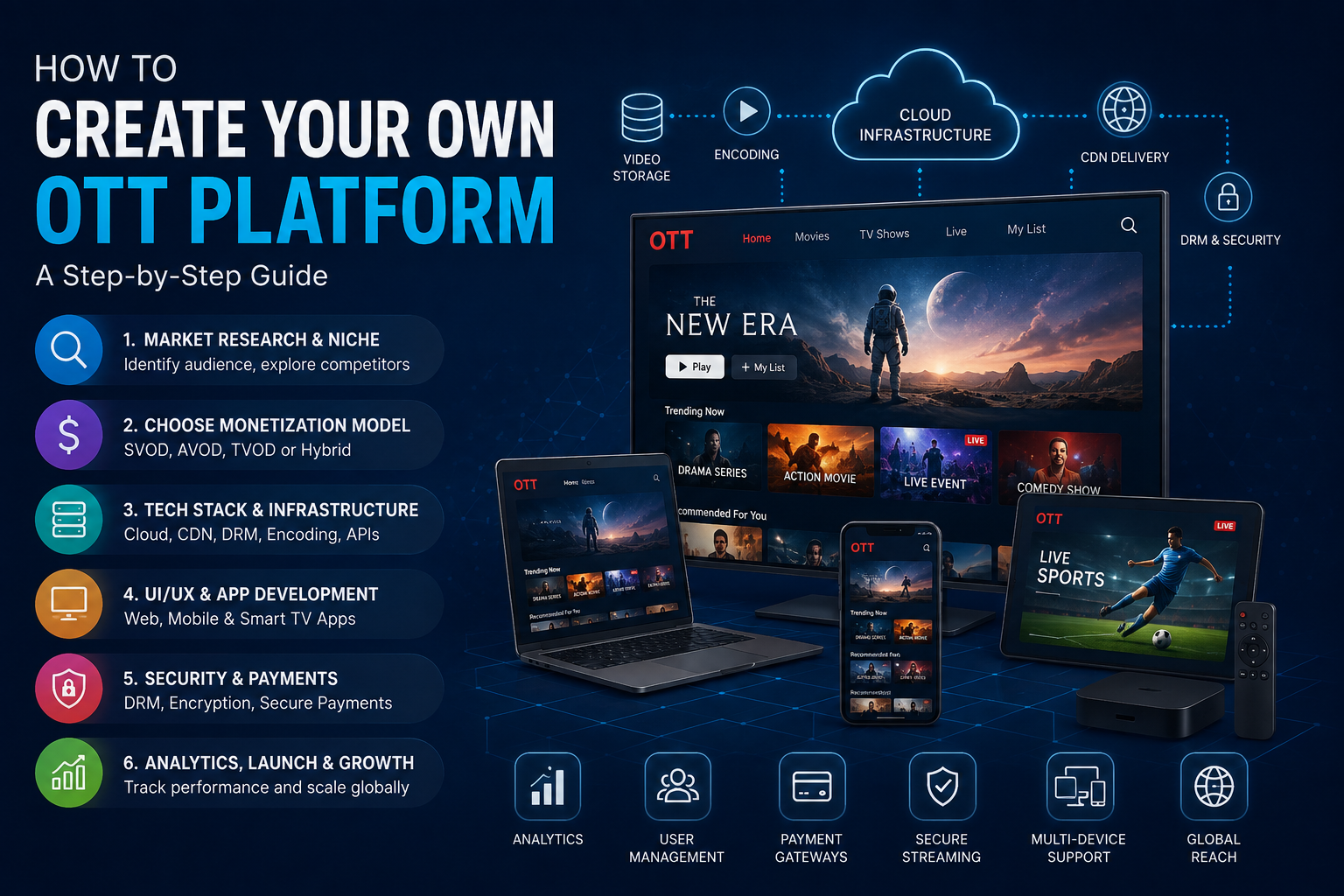
Architecture diagram description
A practical OTT architecture can be represented as:
Admin/CMS → Object Storage → Encoding/Transcoding → Packaging → DRM → Origin → CDN → Web/Mobile/TV Apps → Viewer
Supporting services sit around this pipeline:
Authentication + User Database + Subscription Management + Payment Gateway + Analytics + Recommendation Engine + Monitoring
The key principle is separation of responsibilities. Video processing should not be tightly coupled to the customer-facing application.
A CDN reduces the distance between video content and viewers and helps prevent the origin infrastructure from handling every request directly. Cloudflare describes video CDNs as a way to reduce latency and buffering while reducing pressure on the origin server.
Build From Scratch vs. White-Label OTT
Businesses considering whether to create their own OTT platform generally have two major routes.
| Factor | Custom Development | White-Label OTT |
| Initial investment | Higher | Lower |
| Development time | Longer | Faster |
| Customization | Very high | Depends on provider |
| Infrastructure ownership | Greater control | Provider-dependent |
| Maintenance | Internal responsibility | Shared/provider-managed |
| Best for | Complex or unique products | Faster market entry |
| Scalability | Designed specifically for business | Depends on solution |
A White Label OTT Solutions approach can be useful when the business wants to launch quickly without independently assembling every infrastructure component.
Custom development makes more sense when the OTT product has unusual workflows, proprietary technology, complex integrations, or highly specific business requirements.
Common OTT Platform Use Cases
The technology can support very different businesses.
Entertainment
Studios and production companies can build branded libraries for movies, series, documentaries, or regional programming.
Sports
Sports organizations can combine live events, replays, highlights, subscriptions, sponsorships, and pay-per-view access.
Education
Universities, training providers, and professional educators can create structured video libraries with user accounts, courses, progress tracking, and premium access.
Fitness and Wellness
Fitness businesses can deliver workout libraries, live classes, personalized programs, and subscription packages.
Corporate Training
Organizations can use OTT infrastructure for employee education, customer training, certification content, and private video libraries.
Regional and Niche Media
A focused platform can serve a specific language, community, genre, or geographic audience instead of competing with general entertainment services.
Best Practices for Building an OTT Platform
Start with an MVP
Do not build every possible feature before testing demand.
An initial product may require:
- Content management
- User accounts
- Video playback
- Subscription/payment system
- Basic analytics
- Web and selected mobile apps
- Security controls
Additional TV applications, advanced recommendations, social features, and complex personalization can follow after validation.
Design for Scale From the Beginning
You do not need hyperscale infrastructure on day one, but the architecture should not make future growth unnecessarily difficult.
Use modular services, cloud infrastructure, scalable storage, CDN delivery, automated monitoring, and asynchronous video-processing workflows.
Optimize Playback Before Adding Features
Viewers will forgive a missing feature more easily than constant buffering.
Monitor:
- Startup time
- Buffering ratio
- Playback failures
- Video quality
- CDN performance
- Error rates
Treat Content Metadata as a Product Asset
Titles, descriptions, categories, actors, genres, languages, subtitles, thumbnails, and collections influence both discovery and user experience.
Plan Security Before Launch
Adding DRM, authorization, account protection, and secure playback after the platform is already operating can create unnecessary architectural changes.
Expert Insights
Expert Insight 1: Your content strategy should determine your technology strategy.
A live sports service has very different infrastructure requirements from a small VOD library. Define the viewing experience before selecting the stack.
Expert Insight 2: Do not measure success only by subscriber count.
A growing subscriber base with poor retention can hide serious product problems. Watch engagement, churn, playback quality, and content-level performance together.
Expert Insight 3: Build the business model into the architecture.
SVOD, AVOD, TVOD, and hybrid platforms have different access-control and billing requirements. Choosing monetization late can result in unnecessary redevelopment.
Expert Insight 4: Multi-device support should be prioritized by audience behavior.
Supporting every platform at launch is not automatically the best strategy. Start with the devices your target audience actually uses and expand from there.
Pros and Cons of Creating Your Own OTT Platform
Pros
- Direct relationship with viewers
- Greater control over branding
- Multiple monetization options
- Ownership of first-party audience insights
- Ability to create niche experiences
- Long-term control over distribution
Cons
- Significant initial planning and development
- Ongoing infrastructure costs
- Content licensing and production expenses
- Security and piracy risks
- Application maintenance across devices
- Continuous customer acquisition requirements
The important distinction is that launching an OTT service is not a one-time software project. It is an ongoing digital media business.

FAQs
What are the main steps to create your own OTT platform?
The process generally includes audience and niche research, content planning, monetization selection, technology architecture, video processing, CMS development, application development, payments, security, analytics, testing, and launch.
How much does it cost to create your own OTT platform?
There is no universal price. Cost depends on the number of applications, content volume, live versus VOD requirements, custom functionality, security requirements, integrations, infrastructure, and development approach. A small web-first MVP can require substantially less investment than a multi-device enterprise streaming service.
Can I create my own OTT platform without coding everything from scratch?
Yes. A white-label or managed OTT solution can provide existing infrastructure and platform capabilities, reducing the amount of custom engineering required. Custom development is more appropriate when the business needs unique workflows or functionality.
Which monetization model is best for an OTT platform?
There is no single best model. SVOD works well for recurring premium access, AVOD can attract users with free content, TVOD suits individual purchases or events, and hybrid models combine multiple revenue streams.
What technology is required for an OTT platform?
A typical OTT technology stack includes cloud storage, video transcoding, adaptive streaming, content management, CDN delivery, DRM, authentication, payment processing, analytics, APIs, and applications for the target devices. AWS’s reference architecture, for example, separates storage, transcoding, packaging, delivery, and monitoring into different components.
Which streaming protocols should an OTT platform use?
HLS and MPEG-DASH are common choices for adaptive streaming. HLS supports live and on-demand video and can switch between different bitrate streams according to network conditions.
How do I protect an OTT platform from piracy?
Use a layered approach that can include DRM, encryption, secure authorization, tokenized playback, account protection, watermarking, and monitoring. DRM should be integrated into the video delivery workflow rather than treated as a standalone feature.
Should I build native or cross-platform OTT applications?
The answer depends on the platforms you need to support, available resources, and required device-specific functionality. Native development offers greater platform control, while cross-platform development can reduce duplicated engineering work.
Can an OTT platform serve both the USA and UAE?
Yes. The underlying infrastructure can support international audiences, but the product should account for regional content rights, localization, pricing, payment requirements, language preferences, device behavior, and customer support expectations.
What should I build first when launching an OTT service?
Start with the smallest product capable of delivering a reliable viewing experience and validating demand. A practical MVP typically includes content management, authentication, video playback, monetization, basic analytics, and the most important viewer applications.
Conclusion
To create your own OTT platform successfully, you need to think beyond the streaming player.
The strongest OTT products connect four areas: content, technology, monetization, and user experience. A compelling content library will not compensate for unreliable playback. Excellent infrastructure will not solve a weak business model. And a polished application will struggle if users cannot discover content that makes the subscription worthwhile.
The development process should therefore begin with a clear audience and business objective, followed by the right monetization strategy and a scalable video architecture. From there, businesses can build the CMS, streaming pipeline, applications, payment system, security layer, analytics, and growth infrastructure around actual user requirements.
For companies that need a customized engineering approach, ARYtech provides an opportunity to explore OTT development from the technology and product perspective. Businesses looking for a ready-to-build OTT ecosystem can also evaluate Vodistry as part of their platform strategy.
If your goal is to launch an OTT service for the USA, UAE, or a wider international audience, the next step is to define your content model, target devices, monetization strategy, and technical requirements before development begins.
Ready to build your OTT platform? Start with a technical and business assessment, then choose the architecture that can support your audience today without limiting your growth tomorrow.