
The streaming industry loses billions annually to video piracy and unauthorized credential sharing. For Over-The-Top (OTT) platforms operating in high-value markets like the USA and the UAE, securing premium video content is not just a technical requirement it is a strict legal mandate enforced by major content studios.
Whether you are launching a proprietary streaming app through an established OTT platform development company or deploying customized White Label OTT Solutions, securing licensing rights for Hollywood blockbusters or live MENA sports broadcasts requires enterprise-grade protection. At the core of this defensive infrastructure is digital rights management software.
This guide provides a comprehensive, architect-level breakdown of digital rights management, how it integrates into modern OTT pipelines, and the strategic advantages it offers broadcasters in the United States and the Middle East.
What is Digital Rights Management Software?
To win the featured snippet for what is digital rights management software, here is the direct, technical definition:
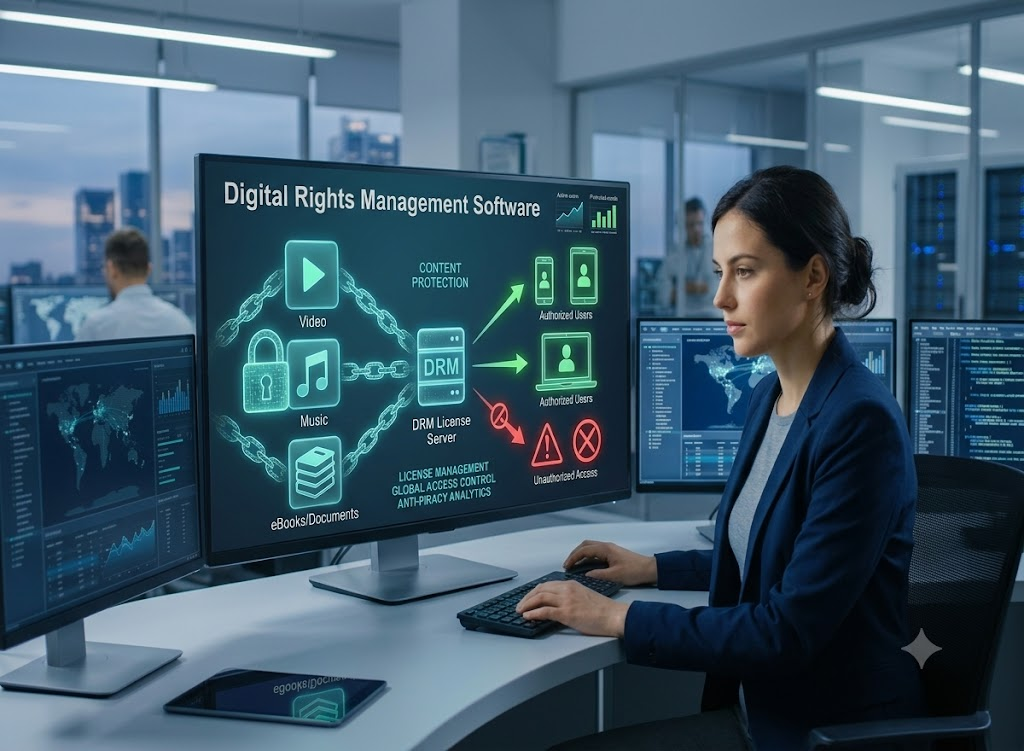
Digital rights management software is a specialized security technology used by content distributors and broadcasters to encrypt digital media, control user access, and prevent unauthorized copying or distribution of copyrighted assets. In the OTT industry, it ensures that only authenticated users with valid subscriptions or purchase tokens can decrypt and playback video content on specific devices.
Unlike basic password protection or standard video encryption (like HLS with AES-128), true digital rights management requires hardware-level integration on the user’s device and dynamic communication with a remote license server.
The Dual Perspective: Business and Technical
Understanding DRM requires looking at it through two distinct lenses: the revenue side and the engineering side.
The Business Perspective
From a commercial standpoint, digital rights management software is a revenue assurance tool.
- Licensing Compliance: Major studios (e.g., Disney, Warner Bros) enforce strict security guidelines. Without a recognized DRM solution, platforms cannot legally distribute premium VOD (Video on Demand) content.
- Monetization Protection: DRM prevents users from using screen-recording software or downloading streams to distribute on illegal torrent sites, safeguarding SVOD (Subscription) and TVOD (Transactional) revenue models.
- Geographic Fencing: It enforces blackout rules for live sports. For instance, an English Premier League match licensed for the UAE cannot be legally streamed by your platform to a user in the USA.
The Technical Perspective
From a technical perspective, DRM is a cryptographic key exchange mechanism.
- Asymmetric and Symmetric Encryption: The video file is encrypted once using a symmetric key. The symmetric key is then delivered to the user securely using asymmetric encryption.
- Content Decryption Module (CDM): DRM relies on a secure hardware or software module built into the device’s operating system or browser (like the secure enclave in iOS).
- License Servers: These servers handle the complex logic of checking user entitlements (e.g., “Does this user have a 4K subscription?”) before issuing the decryption key.
OTT Architecture Diagram: How DRM Works
(Note: Below is a descriptive breakdown of a standard Multi-DRM OTT workflow).
- Ingest & Transcoding: The raw video file is ingested into enterprise Video Content Management Systems and transcoded into adaptive bitrate (ABR) formats (HLS/DASH).
- Packaging & Encryption (The DRM Packager): The packager requests encryption keys from the Key Management System (KMS). The packager encrypts the video segments (using Common Encryption – CENC) and attaches metadata signaling which DRM systems are supported.
- Storage & CDN Delivery: The encrypted video files are stored in an origin server and cached across a Content Delivery Network (CDN) for global distribution.
- Client Request: The user clicks “Play” on their smart TV or mobile app. The video player downloads the manifest file and recognizes that the content is encrypted.
- License Acquisition: The video player extracts the DRM metadata and sends a secure request (including a user authentication token) to the DRM License Server.
- Decryption & Playback: The License Server validates the token via the platform’s backend. If valid, it issues a DRM license containing the decryption key and playback rules (e.g., “allow playback for 48 hours, block HDMI output”). The device’s secure CDM decrypts the video and renders it to the screen.
Regional Focus: Why the USA and UAE Demand Robust DRM
The United States Market
The US is the most mature and fragmented OTT market globally. With high Average Revenue Per User (ARPU), it is a primary target for sophisticated piracy rings.
- Early Access Windows: Premium VOD releases (movies hitting streaming platforms shortly after theaters) require the highest tier of DRM hardware protection to prevent instant pirated 4K rips.
- Complex Syndication: Content ownership in the US often involves complex, highly specific rights (e.g., mobile-only rights, out-of-market sports packages). DRM software dynamically enforces these granular rules.
The UAE and MENA Market
The UAE is a rapidly expanding hub for digital entertainment, driven by high smartphone penetration and massive investments in live sports.
- Live Sports Piracy: The MENA region struggles significantly with illegal IPTV services rebroadcasting live sports (like cricket and football). Real-time DRM key rotation is critical here to disrupt illegal restreaming.
- Regulatory Compliance: Telecommunications regulatory authorities in the UAE strictly monitor digital content distribution, making secure content delivery pipelines a compliance necessity.
Top Use Cases for Streaming Platforms
- Live Sports Broadcasting: Utilizing dynamic key rotation to prevent unauthorized streams from staying alive longer than a few minutes.
- Premium VOD Rentals: Enforcing time-bound licenses (e.g., the user has 30 days to start watching, and 48 hours to finish once started).
- Offline Viewing: Allowing users to securely download episodes to their mobile devices for flights. The DRM software issues an offline license that self-destructs after a specified timeframe.
- Tiered Subscriptions: Serving 1080p content to standard subscribers while restricting 4K HDR streams strictly to premium subscribers using hardware-level DRM checks.
Comparing Leading DRM Solutions
To achieve cross-platform compatibility across modern OTT app development projects, OTT architects must implement a Multi-DRM strategy, integrating the “Big Three” providers.
| Feature / System | Google Widevine | Apple FairPlay | Microsoft PlayReady |
| Primary Ecosystem | Android, Chrome, Android TV, Chromecast | iOS, macOS, Safari, Apple TV | Windows, Edge, Xbox, Smart TVs |
| Streaming Protocol | MPEG-DASH, HLS | HLS | MPEG-DASH, Smooth Streaming |
| Hardware Security | Level 1 (Hardware), Level 3 (Software) | Hardware-backed secure enclave | SL3000 (Hardware), SL2000 (Software) |
| Best For | Mobile apps (Android) and web streaming. | Premium content on Apple devices. | Gaming consoles and Windows PCs. |
Pros and Cons of Implementation
Pros
- Unlocks Premium Content: Satisfies the strict security audits required by Hollywood and major sports leagues.
- Granular Control: Allows platforms to enforce specific rules regarding resolution, output (blocking screen capture), and rental windows.
- Revenue Protection: Drastically reduces casual piracy and credential sharing, directly impacting the bottom line.
Cons
- Integration Complexity: Managing multiple license servers (Widevine, FairPlay, PlayReady) requires specialized engineering expertise.
- Latency Issues: Poorly optimized license server requests can delay video startup time (Time to First Frame), frustrating users.
- Cost: Enterprise DRM solutions and managed Multi-DRM services incur monthly licensing and usage fees.
Architect Best Practices and Expert Tips
Expert Insight:
“Do not attempt to build a DRM license server from scratch. The cryptographic complexity and maintenance of keeping up with browser and OS updates are immense. Instead, leverage a managed Multi-DRM provider or consult with specialized technology partners like ARYtech or platforms like Vodistryto focus your engineering efforts on your frontend player integration and backend entitlement logic.”
Best Practices for Deployment
- Use Common Encryption (CENC): Encrypt your media files once using CENC. This allows you to use a single encrypted video file alongside multiple DRM systems, drastically reducing your storage and CDN costs.
- Implement Forensic Watermarking: DRM stops unauthorized playback, but it cannot stop someone from recording their TV screen with a camera. Pair DRM with dynamic forensic watermarking to trace leaked videos back to the specific user account.
- Optimize License Delivery: Pre-fetch DRM licenses during the app loading phase or while the user is browsing the catalog to ensure instant playback when they click play.
Frequently Asked Questions (FAQs)
1. What is digital rights management software in simple terms?
It is a security lock placed on digital video files. Only users who have the correct “key” (granted by logging in and paying for a subscription) can open and watch the video.
2. Can I use standard AES encryption instead of DRM?
Standard AES-128 encryption (Clear Key) hides the video, but the decryption key is sent in plain text to the browser. Anyone with basic developer tools can find the key and steal the video. DRM hides the key inside secure hardware.
3. Does DRM slow down video streaming?
If configured incorrectly, the time it takes to request and receive the DRM license can add a few hundred milliseconds to the startup time. However, optimized platforms use license pre-fetching so the user notices zero delay.
4. Why do I need a Multi-DRM setup?
Because Apple devices only support FairPlay, Android/Chrome devices rely on Widevine, and Windows devices prefer PlayReady. To reach all users, your platform must support all three simultaneously.
5. How much does digital rights management software cost?
Costs vary based on the vendor and usage scale. Typically, managed Multi-DRM providers charge a setup fee and a fraction of a cent per issued license, scaling with your active user base.
6. Can DRM stop screen recording?
Yes. Hardware-level DRM (like Widevine L1 or PlayReady SL3000) prevents the operating system’s screen capture APIs from accessing the decrypted video frames, resulting in a black screen if a user tries to record.
7. Does DRM work for offline downloads?
Yes. Modern DRM systems support persistent licenses. The OTT app securely downloads the encrypted video and a time-bound DRM license, allowing the user to watch offline until the license expires.
8. What happens when a DRM system updates?
Managed DRM vendors handle the backend updates. However, OTT platform developers must ensure their video player SDKs are regularly updated to maintain compatibility with the latest browser and OS security patches.

Conclusion
Building a successful streaming platform in highly competitive markets like the USA and UAE requires more than just a great content library and a sleek user interface. It requires an ironclad commitment to content security.
Understanding what digital rights management software is and how to architect it seamlessly into your streaming pipeline is the difference between a profitable enterprise OTT business and one crippled by piracy and licensing lawsuits. By adopting a Multi-DRM approach, utilizing Common Encryption, and following stringent backend entitlement protocols, platforms can protect their revenue while delivering flawless viewing experiences to their users.
Ready to secure your streaming infrastructure?
Our team of OTT Solution Architects specializes in integrating enterprise-grade Multi-DRM systems, custom video players, and high-performance backend infrastructures. Contact ARYtech today to audit your current platform security or to start building a studio-compliant streaming service from the ground up.
Leave a Reply