
igital media consumption across the United Arab Emirates and the GCC has reached an enterprise threshold. Driven by widespread 5G infrastructure, high multi-screen adoption, and expanding OTT ecosystems across Dubai, Abu Dhabi, and Riyadh, media organizations are managing massive VOD catalogs alongside high-concurrency live feeds. At the heart of every successful streaming architecture lies a high-performance enterprise video cms that orchestrates ingestion, metadata alignment, DRM licensing, dynamic ad placement, and multi-platform publishing.
A generic web content management system cannot handle the operational complexities of digital video workflows. An enterprise-grade video content management system must serve as an API-first media engine that interfaces with transcoding clusters, dynamic packagers, multi-DRM gateways, and regional payment providers. Partnering with an established OTT platform development company UAE enables media publishers, broadcasters, and telecoms to streamline video operations while maintaining broadcast-grade reliability.
This architectural guide delivers a blueprint for evaluating, building, and scaling an enterprise video cms tailored to the Middle Eastern broadcast and digital media landscape.
Executive Overview: What Defines an Enterprise Video CMS?
At its core, an enterprise video cms acts as the central command hub for an entire streaming pipeline. Unlike standard content management tools that manage static web pages or text assets, a video-centric engine orchestrates complex video-first workflows: video asset ingestion, automated transcode profiles, adaptive bitrate packaging, multi-language subtitle tracks (WebVTT), localized artwork, rights management, and API delivery to native client applications.
Critical Operational Capabilities
- Scalable Metadata Orchestration: Manages thousands of VOD assets, live channel schedules, episodic hierarchies, season structures, and localized metadata in parallel.
- Granular Rights & Geo-Fencing Control: Enforces strict territorial windowing rules to comply with content licensing agreements across regional territories.
- High-Throughput Headless API Layer: Delivers low-latency JSON and gRPC metadata payloads to iOS, Android, Smart TVs (Samsung Tizen, LG WebOS), Apple TV, and web apps.
Formulating an effective media strategy requires establishing a structured OTT Business Plan that balances cloud processing overhead against subscriber acquisition and retention goals.
Core Architectural Pillars & API-First Metadata Engine
An enterprise video engine uses a decoupled, headless microservices architecture that separates content governance from front-end user experience layers.
Ingestion, Transcoding, and Metadata Governance
- Automated Asset Ingestion: Supports mass file uploads via S3/GCS buckets, hot folders, and direct live feed ingestion (SRT/RIST/RTMP).
- Metadata and Asset Taxonomy: Manages multi-language titles, descriptions, cast profiles, age ratings, and genre tags.
- Multi-Region Localization: Content owners managing regional libraries require tailored localized systems, such as a dedicated video cms uae or an enterprise video cms ksa, to handle regional compliance, localized posters, and Arabic/English metadata alignment. Deploying a unified core Video CMS ensures editorial teams maintain a single source of truth across all regional operating hubs.
Integrating specialized Video Content Management Systems simplifies complex content workflows, giving editorial teams full control over dynamic scheduling, EPG publishing, and catalog curation.
Architectural Flow: Ingestion, Security, and Distribution
An enterprise video CMS operates within a continuous end-to-end cloud pipeline, coordinating every step from raw file ingestion to end-user playback:
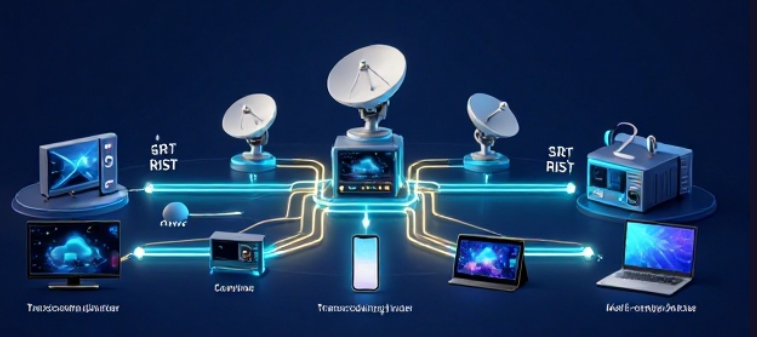
- Source Ingestion: Raw mezzanine video files and live feeds pass into cloud encoding clusters.
- Transcoding & ABR Packaging: Video assets are processed into H.264, HEVC, or AV1 ladders and dynamically packaged into HLS and MPEG-DASH manifests.
- CMS Metadata & Rights Processing: The enterprise video CMS attaches metadata, subtitle tracks, geo-blocking rules, and monetization tags to the asset.
- Security & Monetization Integration: Streams pass through a Multi-DRM Gateway (Widevine, FairPlay, PlayReady) and a Server-Side Ad Insertion (SSAI) engine.
- CDN Distribution & Client Playback: Assets are served via a multi-CDN network to native client applications on mobile, web, and Smart TV platforms.
Regional Requirements: Localization and Multi-Region Asset Management
Managing digital video catalogs across the UAE and GCC demands localized capabilities tailored to Middle Eastern audiences:
- Arabic / English Bi-Directional Metadata: Full support for Right-to-Left (RTL) Arabic typography and localized metadata fields across all client endpoints.
- Content Censorship & Compliance Windowing: Custom workflow states (Draft, Under Review, Compliance Approved, Published) that allow regional compliance teams to edit scenes or adjust age ratings before public release.
- Telecom Billing Integration: Deep integration with regional Direct Carrier Billing (DCB) gateways (such as e& and du in the UAE) to enable seamless micro-transactions.
Security Stack: Studio-Compliant Multi-DRM and Access Control
Securing premium video assets against regional piracy requires studio-compliant protection built directly into the video management workflow.
1. Unified Multi-DRM Integration
Securing high-value media rights requires deploying comprehensive Digital Rights Management supporting three core DRM platforms simultaneously:
- Google Widevine (L1/L3): Secures Android devices, Chrome browsers, and Android TV hardware.
- Apple FairPlay Streaming: Encrypts HLS streams delivered across iOS, macOS, and Apple TV.
- Microsoft PlayReady: Protects DASH streams on Smart TV platforms (Samsung Tizen, LG WebOS) and Windows.
Utilizing dedicated Digital Rights Management Software simplifies license key exchanges and enforces strict playback restrictions. Organizations upgrading legacy security layers can execute a seamless OTT DRM Replacement strategy to maintain uninterrupted service for active subscribers. Learn more about token security mechanisms in our guide on Multi DRM.
2. Geo-Fencing & Dynamic Watermarking
The CMS must enforce strict territorial access controls using IP intelligence data to block VPNs and unauthorized access outside licensed regions. Furthermore, session-based forensic watermarking embeds unique viewer IDs into video playback buffers to trace restreaming sources in real time.
Dynamic Monetization Integration: SVOD, AVOD, SSAI, and FAST
An enterprise video CMS serves as the financial engine of a streaming service, coordinating revenue parameters for every title in the catalog.
Subscription Management (SVOD): Maps tier-based access rights to specific video categories or premium live events.
Ad Break Signaling (AVOD & FAST): Inserts SCTE-35 cue points into video manifests to trigger Server-Side Ad Insertion (SSAI) engines for targeted, buffer-free ad delivery.
Telco Bundling Partnerships: Expands platform reach by supporting wholesale distribution frameworks, such as regional OTT Bundling Models.
Consulting with technical advisors through specialized OTT Consulting Services helps media brands build robust commercial stacks. Implementing structured OTT Monetization Services maximizes eCPM yields while minimizing viewer drop-off.
Build vs. Buy Financial Evaluation Matrix
Broadcasters and publishers evaluating an enterprise video cms must weigh custom software development against customizing an established platform engine.
| Evaluation Metric | Bespoke Custom CMS Build | Modular Enterprise CMS Engine |
| Time-to-Market | 9 to 18 Months | 2 to 4 Months |
| Upfront CapEx | High ($150,000 – $400,000+) | Moderate ($20,000 – $60,000) |
| In-House DevOps Needs | Large Dedicated Engineering Team | Minimal; Vendor-Managed |
| API & Smart TV Connectors | Must be coded from scratch | Pre-built REST/gRPC endpoints |
| Ongoing Maintenance | 15% – 20% of build cost annually | Covered under managed SaaS OpEx |
| Customization Depth | 100% Bespoke | High via configurable API schemas |
Broadcasters seeking to deploy White Label OTT Solutions can significantly reduce initial capital expenditure. Media companies planning to create your own OTT platform often select managed platform engines to accelerate launch timelines while maintaining high operational flexibility.
Real-World Regional Deployment Scenarios
Scenario 1: UAE Regional Broadcaster – Live & VOD Catalog Scale
- Challenge: Manage a 20,000-hour VOD catalog alongside high-concurrency live news feeds, serving multi-lingual audiences across Dubai and Abu Dhabi.
- Solution Architecture: Deployed a headless enterprise video CMS connected to auto-scaling cloud packagers, a multi-DRM gateway, and direct carrier billing gateways.
- Outcome: Streamlined editorial publishing times by 65% while achieving 99.99% playback reliability during peak live news events.
Scenario 2: Media Publisher – FAST Channel & SSAI Expansion
- Challenge: Convert static archival video assets into five automated 24/7 linear FAST channels monetized through dynamic video ad insertion.
- Solution Architecture: Implemented a cloud playout engine managed via a central Video CMS, utilizing automated SCTE-35 ad cue triggers for SSAI ad insertion.
- Outcome: Opened new ad revenue streams from archival libraries without increasing manual editorial overhead.
Turnkey Enterprise Solution: Vodistry by ARYtech
For media organizations seeking a complete enterprise video engine without long development cycles, modern platform engines offer a proven path forward.
The Vodistry platform—engineered by ARYtech—delivers a modular streaming engine built specifically for high-scale enterprise environments. Core platform capabilities include:
- High-Concurrency Live Streaming: Ingest low-latency live streams and distribute them reliably across global multi-CDN networks.
- Automated Cloud playout: Assemble 24/7 linear channels from existing VOD assets using automated EPG schedulers.
- Real-Time video Analytics: Monitor Quality of Experience (QoE) metrics, buffer ratios, and subscriber retention rates through a unified dashboard.
- Dynamic UX Management: Use a low-code Experience builder to update client app layouts and category rows dynamically without submitting app store updates.
- Interactive Viewer Extensions: Increase watch times using built-in interactive tools like live polling and chat through integrated Interactivity modules.
Whether launching modern OTT Streaming Services or integrating complex backend workflows via OTT System Integration, selecting a managed platform engine removes technical risk while lowering operational costs.
Strategic Architecture Verdict & Implementation Roadmap
Selecting the right enterprise video cms is a foundational decision that determines a media organization’s operational efficiency, content security, and monetization potential. As regional audience demand for high-definition VOD, low-latency live events, and personalized streaming experiences grows across the UAE and GCC, investing in a robust, API-first video engine is essential for long-term growth.
Whether you are launching a new direct-to-consumer media platform or upgrading an existing video pipeline, working with experienced architects ensures your platform delivers broadcast-quality performance across every screen. Explore specialized media solutions through ARYtech and review modern platform options like Vodistry to build a secure, high-concurrency streaming ecosystem.
Frequently Asked Questions (FAQs)
1. What is an enterprise video CMS?
An enterprise video CMS is a headless, API-driven software architecture designed specifically to manage, organize, transcode, secure, monetize, and publish large VOD video catalogs and live streaming feeds across multi-device applications.
2. How does an enterprise video CMS differ from a standard web CMS?
Standard web CMS platforms manage static text, images, and simple web pages. An enterprise video CMS handles video-specific workflows, including adaptive bitrate transcoding, dynamic manifest packaging, studio-grade Multi-DRM key delivery, SCTE-35 ad break signaling, and multi-CDN switching.
3. Why is Multi-DRM support necessary within a video CMS?
Multi-DRM support is required to comply with studio content licensing rules. Integrating Widevine, FairPlay, and PlayReady into the CMS workflow ensures video streams are encrypted and playable across Android, Apple, and Smart TV ecosystems.
4. How long does it take to deploy an enterprise video CMS?
Building a bespoke video CMS from scratch typically takes 9 to 18 months. Deploying a modular, managed platform engine like Vodistry allows media organizations to go live in 60 to 90 days.
5. What payment integrations should a Middle Eastern video CMS support?
An enterprise video CMS serving the UAE and GCC should support credit card checkouts, digital wallets (Apple Pay, Google Pay), and Direct Carrier Billing (DCB) through regional operators like e& and du.
6. What is the role of a headless API in a video CMS?
A headless API decouples the backend video management engine from the front-end user applications. This allows editorial teams to update metadata, change categories, or publish new videos once, automatically delivering updates to iOS, Android, Smart TV, and web apps simultaneously.
7. How does a video CMS support dynamic ad insertion (SSAI)?
The video CMS inserts SCTE-35 markers or ad break cues into video asset manifests, signaling the Server-Side Ad Insertion (SSAI) engine to stitch targeted digital commercials directly into the video stream at the cloud level.
8. Can an enterprise video CMS handle live streaming and cloud playout?
Yes. Modern enterprise video engines manage both VOD catalogs and live streams, enabling editorial teams to schedule VOD assets into 24/7 linear cloud playout channels (FAST channels) with automated EPG generation.
Leave a Reply